 Protein Networks
- Protein Networks
- Why protein powder can make cakes dry, and which baking mistakes matter
An essay
Why protein powder can make cakes dry, and which baking mistakes matter
Understand how replacing flour changes starch, gluten and water balance, why hardness differs from dryness, and how measuring, mixing and baking choices affect the crumb.
The journal's automated checks of this essay's content and sources passed on , and this version appeared after they did. Read the health disclaimer.
In this essay
- Replacing flour changes more than the protein content
- Water balance needs more thought than an extra splash
- Whey and pea protein behave differently across cake recipes
- Changing sugar and fat can create a separate texture problem
- Measuring and mixing mistakes can obscure the flour substitution
- Check the oven, then compare the cooled crumb
Replacing flour changes more than the protein content
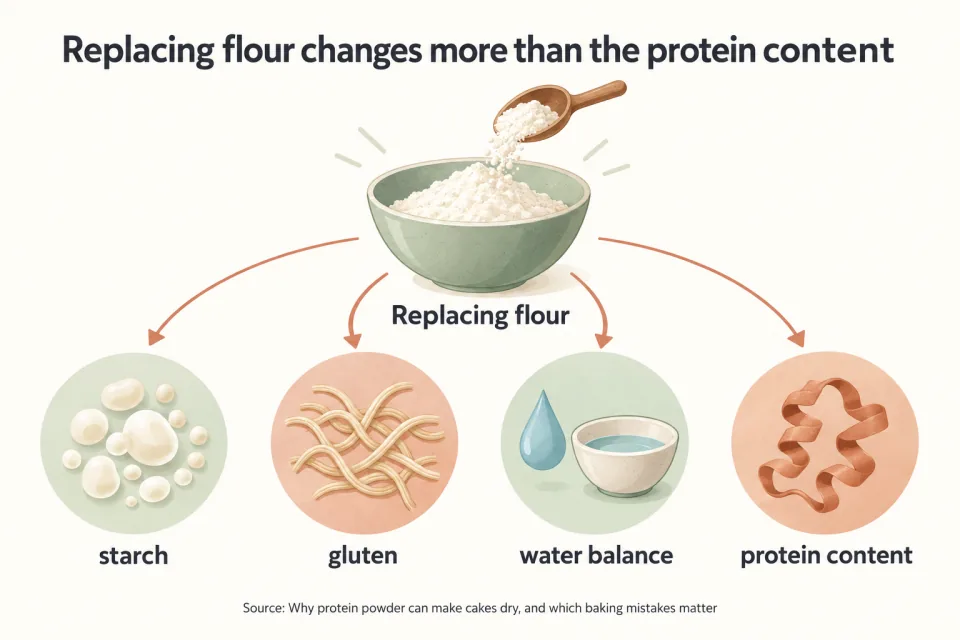
Replacing flour with protein powder changes the ingredients responsible for cake structure and the way water is shared through the batter. Dryness can follow several different recipe changes, so the powder substitution needs to be considered alongside mixing, sugar, fat and baking.
Wheat flour contributes proteins that form gluten when mixed with water. Gluten is a protein network that gives the batter strength and structure, as Vanderbilt University's explanation of baking describes. Whey adds protein, but replacing wheat flour with whey does not preserve the same gluten structure. In the wheat sponge-cake experiment published in Foods, that substitution diluted gluten and weakened the batter.
Starch has a different role. The Exploratorium explains gelatinisation as the process in which starch granules take up liquid and swell. Replacing some flour therefore changes the starch portion of the recipe as well as its wheat proteins. Looking only at the added protein misses what has been removed with the flour.
These changes can produce a cake that feels disappointing in several ways. The whey-containing wheat sponge cakes had less volume relative to their weight and were harder, chewier and gummier than the comparison cake. Those descriptions concern different qualities of the crumb. A low cake, a firm cake and a cake that seems dry should be recorded separately when assessing a bake.
The distinction matters when deciding what to change next. If a cake is firm but holds its shape, adding liquid addresses a different part of the recipe from changing the mixing method. If it is flat, the questions include how much air entered the batter and how well the batter retained its structure. Calling every result dry can send the next attempt toward the wrong adjustment.
Taken together, the sources support an explanation involving changes in starch, gluten and the distribution of water. This is a synthesis of the baking explanations and cake experiments. It provides a way to examine a flour substitution without assuming that every powder will behave alike or that every firm crumb has the same cause.
Water balance needs more thought than an extra splash
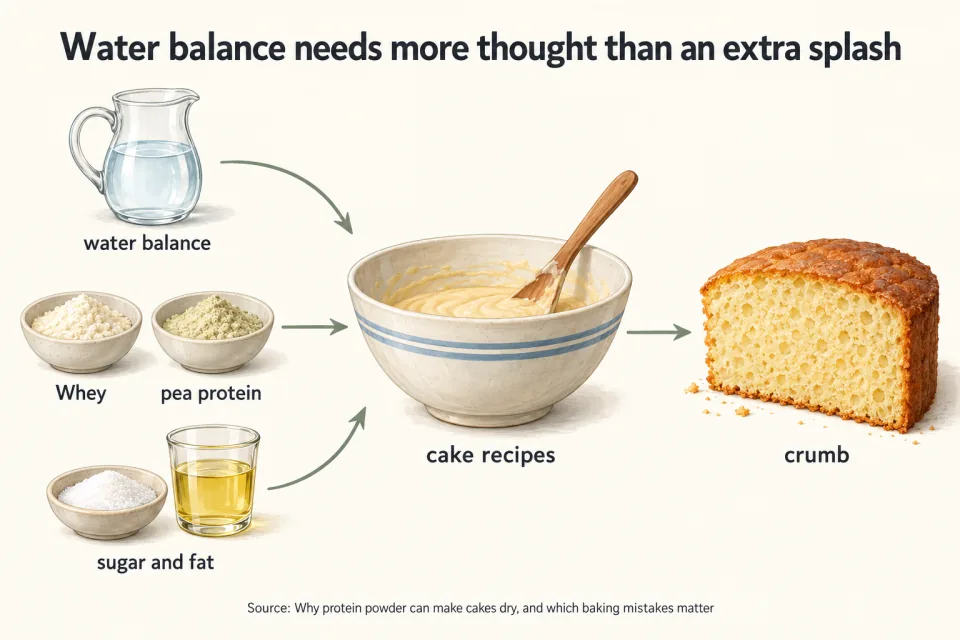
Water balance concerns how ingredients share the liquid in a batter, as well as how much liquid the recipe contains. The wheat sponge-cake researchers described ingredients competing for a limited supply of water. That makes an unchanged liquid quantity something to examine after flour replacement, rather than automatic evidence of a balanced batter.
Starch takes up liquid as it swells, while water also participates in gluten formation. Sugar adds another demand. The wheat sponge-cake authors proposed that whey left less water available to dissolve sugar, allowing sugar crystallisation during baking to affect texture. Their explanation was a proposed mechanism, so it should remain separate from the texture differences they measured.
This distinction gives a practical way to think about a stiff batter. Record its appearance, but do not use thickness alone to decide that the finished cake will be dry. In the rice-flour experiment, the authors linked the lower volume of cakes containing only pea protein to viscosity potentially limiting expansion. Viscosity means resistance to flow; a thick batter can present a problem for expansion as well as a question about liquid.
Adding liquid freely creates a different uncertainty. The University of Illinois cake guide identifies both excessive and insufficient liquid as possible contributors to a flat or sunken cake. A correction aimed at dryness can therefore change the cake's shape without resolving the original texture problem. The guide's explanation supports measuring liquid carefully rather than judging it only by how easily the batter pours.
For a recipe adjustment, write down whether the flour changed, whether liquid changed and whether sugar changed at the same time. Keep these observations separate from the finished cake's height and firmness. This is an editorial way to organise a comparison: it helps distinguish an intentional recipe change from an unrecorded splash added during mixing.
For example, a thick batter followed by a short cake raises a different question from an ordinary-looking batter followed by dry edges. The first comparison directs attention toward formulation and expansion; the second also calls for checking the baking conditions. Neither observation, by itself, selects a liquid adjustment. Use the whole sequence from mixing to cooled crumb when deciding which part of the recipe to examine.
Whey and pea protein behave differently across cake recipes
A powder's effect depends on the flour and the rest of the cake mixture. The wheat sponge-cake experiment and the rice-flour layer-cake experiment produced different volume results with whey. Reading them together is more useful than assigning whey a fixed reputation for making cakes either light or dense.
In the wheat experiment, replacing flour with whey weakened the gluten-containing batter and reduced volume relative to cake weight. The rice-flour experiment began with a different flour system and compared egg-white, whey and pea proteins. Increasing whey’s share of the protein mixture increased volume relative to weight in those rice-flour cakes. The starting recipe is therefore part of the comparison, not background detail that can be ignored.
The rice-flour researchers associated whey-rich batters with lower density and more trapped small air bubbles. Cakes enriched only with pea protein had lower volume relative to weight than the comparison cake, which the authors linked to viscosity potentially restricting expansion. These findings connect the powder choice to the batter's handling of air and its resistance to expansion. They do not make batter thickness a reliable ranking of eventual cake quality.
A taller cake also needs a separate texture assessment. Whey-rich rice-flour formulations lost more mass during baking, and the researchers proposed greater evaporation from their larger surfaces as an explanation. In the maize-and-rice sponge-cake study, whey increased hardness despite reported improvements in volume and baking loss. Height, firmness and loss of mass during baking can move in different directions.
The mixture experiment also found better appearance and texture ratings when proteins were combined than when pea or egg-white protein was used alone. That result belongs to the tested mixtures. It supports paying attention to the full formulation when comparing recipes, rather than transferring the outcome from a cake made with a different flour or protein combination.
For a useful recipe comparison, start by matching the flour system and cake style, then examine the named protein ingredient. A wheat sponge, a rice-flour layer cake and a maize-and-rice sponge are distinct starting points. If the aim is to understand why an existing cake became dry or tough, a closely matched recipe offers a clearer comparison than a tall cake made from a substantially different mixture.
Changing sugar and fat can create a separate texture problem
Reducing sugar or changing fat alongside a powder substitution introduces additional causes of texture changes. Alabama Cooperative Extension explains these ingredient functions for shortened cakes, meaning cakes made with added fat. Its guidance gives reasons to examine sugar and fat independently when a reformulated cake seems dry.
Sugar contributes tenderness, a fine crumb, moistness and crust browning in these cakes. Reducing it can produce a drier, more open crumb with less volume and faster drying during storage. A cake changed by both flour replacement and sugar reduction therefore gives no clean comparison of the powder's effect. Keeping a record of both changes prevents the sugar adjustment from disappearing from the explanation.
Sweetness alone does not account for sugar's contribution. Alabama Cooperative Extension notes that non-caloric sweeteners do not perform all of sugar's structural and textural functions. Matching the sweetness of the original cake is consequently a different task from preserving its crumb. When comparing recipes, read the sugar change as an ingredient-function change as well as a flavour change.
Fat also contributes to fine cake texture, and the extension guidance recommends specially formulated recipes when oil replaces solid fat. Kansas State University's explanation of creaming shows why the method matters: sugar crystals create small air pockets in butter that later contribute to lift. Substituting oil while retaining instructions built around creaming butter changes an important part of that process.
Even with butter unchanged, its condition can affect the result. The Illinois guide explains that butter that is too cold or too warm traps air poorly during creaming and can leave a cake flat or dense. Before blaming the powder for a low cake, compare the butter preparation and mixing method with the recipe. That check addresses an ordinary cake-making variable that remains relevant after protein powder is introduced.
An editorial comparison can begin with the original cake and a powder-containing version that retains the original sugar, fat and mixing method. Examine any intended sugar or fat changes separately afterward. This arrangement does not specify a powder quantity; it makes the source of a texture difference easier to discuss. If several ingredients were already changed together, use the recipe notes to choose a clearer comparison for the next bake.
Measuring and mixing mistakes can obscure the flour substitution
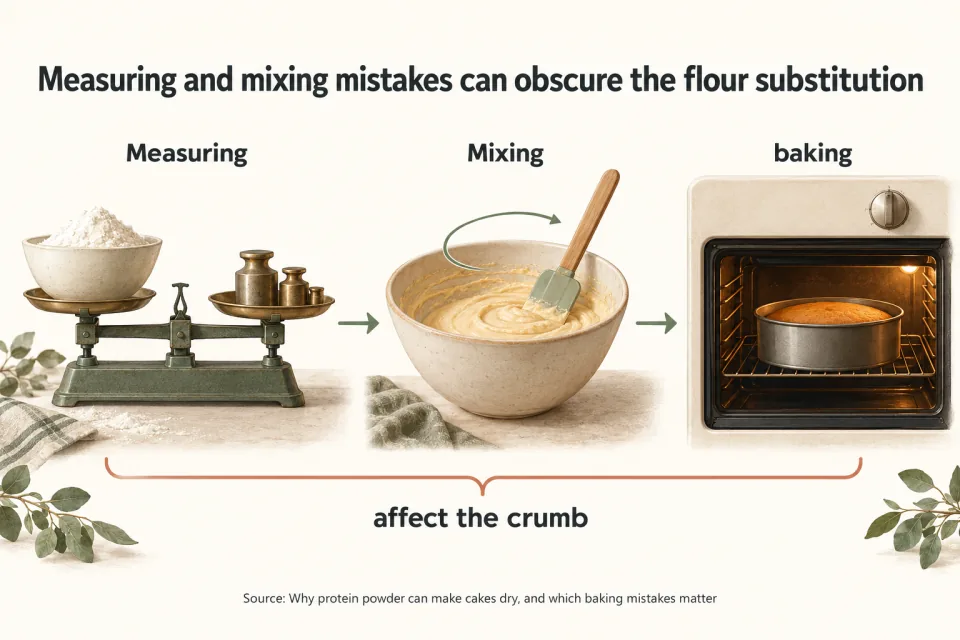
Accurate measuring and the recipe's intended mixing method make a powder experiment easier to interpret. The Illinois troubleshooting guide lists excess flour among the possible causes of a dry cake. A measurement error can therefore add dryness before any conclusion about the powder is warranted.
For its cake recipes, New Mexico State University directs cooks to spoon flour lightly into a measuring cup and level it instead of packing it. The Illinois guide also distinguishes flour sifted before measuring from flour measured before sifting. Follow the sequence written in the recipe, and record any departure. Otherwise, a comparison intended to examine a flour substitution may also contain a flour-measurement change.
Flour type belongs in that record too. New Mexico State University advises using the specified flour because cake flour and all-purpose flour give different textures. A recipe developed with cake flour is a different starting point from an otherwise similar recipe made with all-purpose flour. Regard a flour-type change as part of the formulation when comparing the results.
Mixing requires similar care. The Illinois guide links overmixing after all-purpose flour is added with greater gluten development and a coarse cake texture. Extra beating is therefore a poor default response to a batter that looks unfamiliar after powder is added. New Mexico State University's method uses low speed during dry and liquid additions, with frequent scraping of the bowl.
Ingredient order can alter tenderness without changing the ingredient list. Kansas State University explains that alternating dry and wet additions after creaming limits gluten development. In reverse creaming, butter coats the flour before liquid arrives, limiting protein hydration, or contact with water, and gluten development. Reverse-creamed cakes can be shorter and flatter while still being tender, so height alone cannot judge whether mixing worked as intended.
Foam-based cakes need their own method. Vanderbilt describes eggs forming a layer around batter bubbles, while the Illinois guide warns that overbeaten egg whites can become dry and clumpy. Vigorous stirring after the whites are incorporated can also sacrifice foam volume. If the recipe relies on beaten whites, record their appearance and the folding step instead of regarding additional beating as a general way to improve the batter.
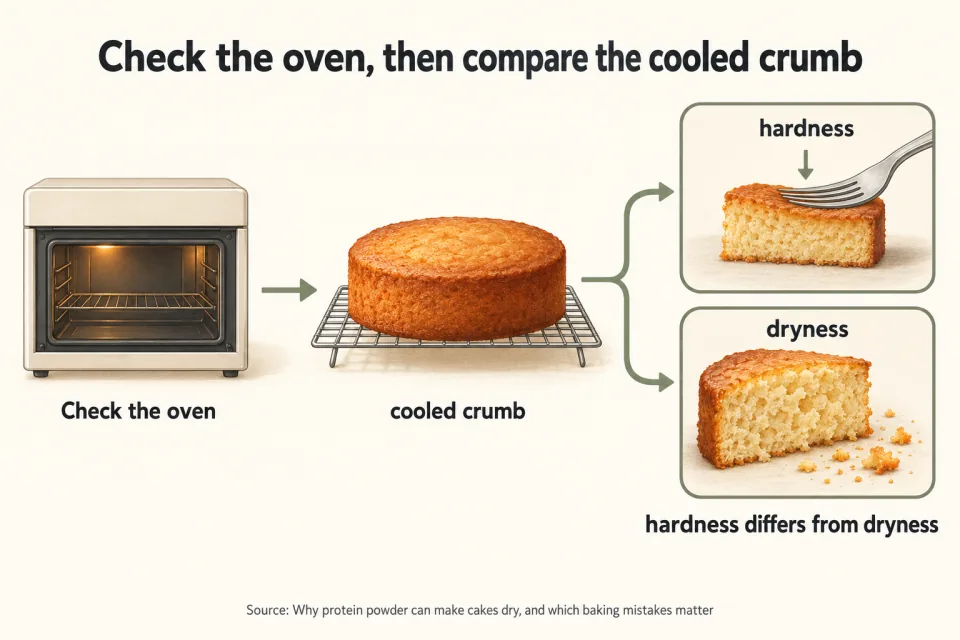
Check the oven, then compare the cooled crumb
Baking conditions deserve a check before the next ingredient adjustment because excessive baking time and an overly hot oven can make cake dry. The Illinois troubleshooting guide identifies both causes. Powder substitution may be the most noticeable recipe change, but it does not remove these ordinary explanations.
New Mexico State University advises judging doneness rather than waiting for an exact stated time because oven accuracy affects baking time. It also explains that an oven thermometer can show whether the actual temperature matches the setting. Use the recipe's doneness instructions alongside that temperature check. Record when the cake appeared done rather than assuming that the printed baking time describes every oven.
Pan choice belongs beside the oven setting in the comparison. The Illinois guide notes that dark pans and glass dishes absorb more heat than shiny metal pans. If the pan changed along with the recipe, include that change in the baking notes. Keeping the pan consistent makes the comparison easier to interpret without assigning every difference to the flour replacement.
Crust colour needs separate attention. In the wheat sponge-cake experiment, whey and sourdough additions produced darker crusts, which the researchers attributed to Maillard reactions, a form of browning during baking. Colour can therefore change with the formulation itself. Compare browning with the recipe's other doneness checks instead of expecting an altered cake to match the original shade exactly.
After baking, New Mexico State University advises cooling cakes completely on a wire rack before frosting or storage. Compare the cooled cakes at the same stage, and keep any later storage observations separate. In the rice-flour mixture experiment, every cake became harder during storage; the authors suggested changes in starch called retrogradation as the main explanation. Firmness after storage is therefore a separate observation from the crumb immediately after cooling.
A useful troubleshooting sequence is to check the measured ingredients, mixing record, pan and oven, then examine height, crumb and storage changes separately. This sequence is an editorial synthesis of the research and extension guidance. For a dry, coarse cake, examine flour measurement and mixing as well as baking time; for a flat cake, examine liquid balance, creaming or foam handling, and the flour substitution. Choose the next comparison around the observed problem, keeping the other recipe details consistent so the result answers a specific question.
Notes
Works consulted
- Effect of Sourdough and Whey Protein Addition on the Technological and Nutritive Characteristics of Sponge Cake
- Optimisation of protein-enriched gluten-free layer cakes using a mixture design
- Optimization of gluten-free sponge cake fortified with whey protein concentrate using mixture design methodology.
- Mixing Matters
- Altering Recipes for Better Health
- Cake and Mix Recipes for High Altitudes in New Mexico
- The Chemistry Behind Baking
- Science of Cooking: Ask the Inquisitive Cooks!
- 4-H Cooking 301
From the journal's records
No writer is named: the essay is credited to the journal, Protein Networks.
It cites 9 sources.