 Protein Networks
- Protein Networks
- Why higher protein cannot guarantee muscle retention during weight loss
An essay
Why higher protein cannot guarantee muscle retention during weight loss
How training, the size of an energy deficit, study design and measurement methods limit claims about protein and muscle retention during weight loss.
The journal's automated checks of this essay's content and sources passed on , and this version appeared after they did. Read the health disclaimer.
In this essay

A guarantee goes beyond the evidence
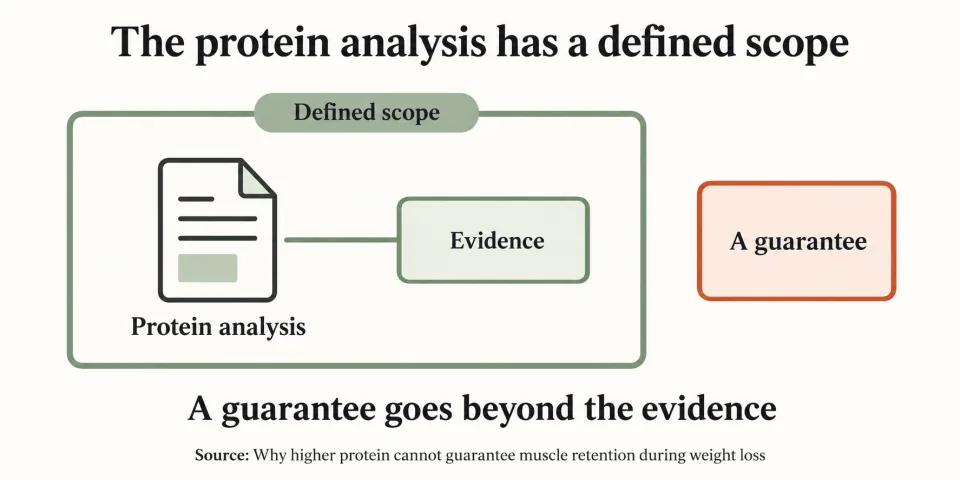
A guarantee of muscle retention goes beyond what this research can establish about higher protein during weight loss. The studies need to be read alongside their training conditions, energy restriction, duration and measurement methods. Those details determine what a comparison can answer and how narrowly its conclusions should be expressed.
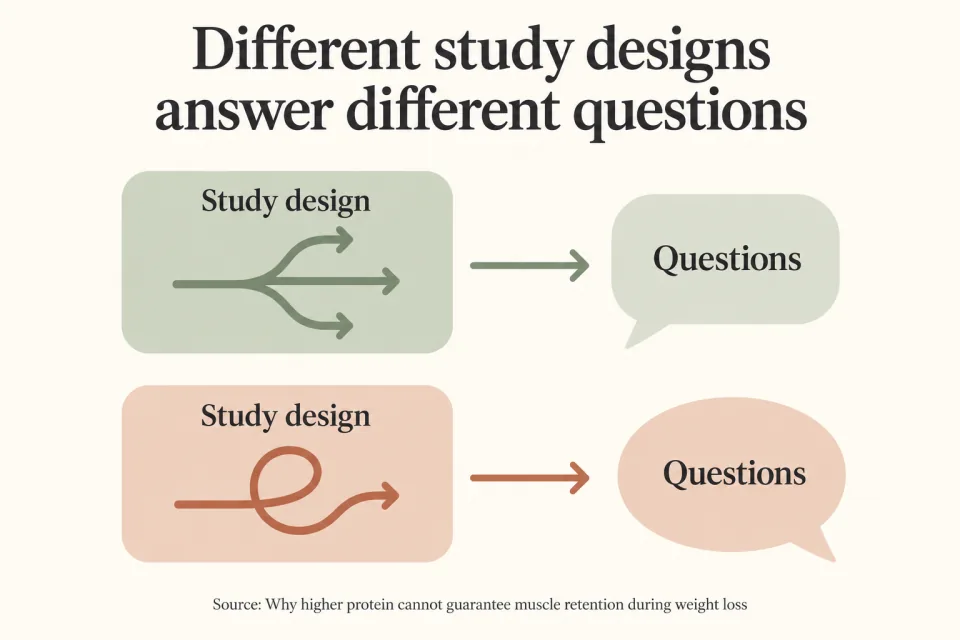
Energy restriction means eating less energy than is needed to maintain energy balance. In the research discussed here, protein sits within that wider dietary setting. A study may compare protein intakes, change energy intake while keeping protein the same, or combine a dietary comparison with different exercise exposures. These designs address different questions, even when their titles use similar language about protein and lean mass.
The recent Refalo analysis describes its findings as exploratory because the studies differed from each other. The separate analysis of training volume also says its correlational evidence cannot support strong conclusions about cause and effect. Together, these qualifications limit how confidently a headline can attribute a measured change to protein alone. A relationship across studies requires more interpretation than a simple statement that more protein guarantees a particular result.
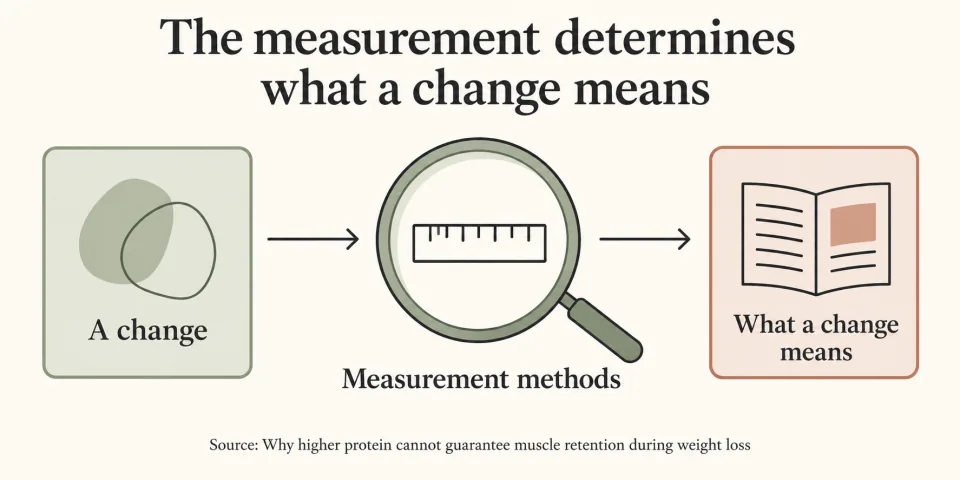
The outcome label needs equal care. Researchers may report fat-free mass, bone-free lean tissue, muscle thickness or muscle volume. These measurements are not interchangeable: the measurement paper explains that different tools examine different aspects of muscle size and body composition. A claim about muscle retention should therefore identify the measurement behind it before drawing a broader conclusion.
For a reader assessing a claim, the useful starting point is the comparison the researchers actually made. Establish what differed between the groups, what remained similar and what the instrument recorded. That sequence makes it possible to separate a dietary question from an exercise question or a measurement question. It also keeps a general statement about protein from becoming a promise about an individual person's body.
The protein analysis has a defined scope
The Refalo analysis concerns people with weight-training experience who followed standardized resistance training during energy restriction. Its scope matters because the research question already includes an exercise setting. Reading the findings as a statement about protein under any weight-loss conditions would remove part of the comparison.
The Refalo analysis drew on 29 studies whose participants had at least three months of resistance-training experience. Resistance training is the form of weight training considered in these studies. The experience requirement identifies the population being examined; it does not describe every adult who might encounter a protein headline. When assessing relevance, keep that participant description attached to the findings.
The researchers examined intervention duration, the size of the energy deficit, starting body-fat percentage and participant sex as possible explanations for differences between findings. An energy deficit describes the gap between energy intake and energy requirements. Its size was therefore part of the analysis, alongside protein. The duration of the dietary phase was another separate feature, so a protein comparison should not be read without its time frame.
The analysis used Bayesian methods to fit linear and nonlinear meta-regression models and estimate uncertainty. In plain language, meta-regression examines whether characteristics of studies are associated with differences in their findings. Linear and nonlinear models allow the researchers to examine differently shaped relationships. These are ways of analyzing the evidence, rather than additional experiments in which every other condition was held constant.
The authors' description of the findings as exploratory belongs with any account of this work. A model can examine possible explanations while leaving uncertainty about their meaning. Asking whether protein, deficit size or study duration helps explain variation is different from establishing a rule that applies to every combination of those conditions. The reported uncertainty is part of the answer.
This distinction also helps when reading a graph or a headline drawn from the analysis. Start with the population and the conditions represented, then consider the relationship being described. A smooth line through study findings should still be read alongside the authors' qualifications. The appropriate question is how the analysis characterizes the evidence within its scope, rather than what personal guarantee can be extracted from it.
Training details belong beside the dietary comparison
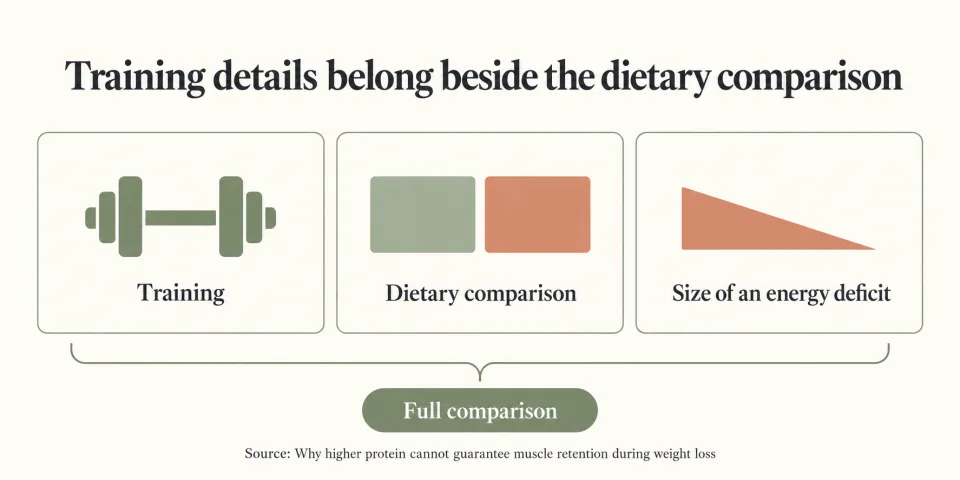
Training exposure is part of the evidence, so a protein comparison needs more detail than a statement that participants exercised. The training-volume analysis examined studies combining energy restriction with high-protein diets. It focused on how the amount of resistance training was described and how that information related to interpretation.
The training-volume analysis included 15 studies, but only four supplied enough detail to calculate total lifting tonnage or weekly sets per muscle group. Lifting tonnage is calculated by multiplying repetitions, sets and external load. This is a specific description of training work, whereas a general label such as weight training leaves much of the study setting unstated. The limited reporting restricted the comparisons the authors could make.
The authors identified previous training volume, training experience, the energy deficit and concurrent aerobic training as relevant context. These details help describe what participants were doing before and during the dietary phase. For example, a report that names the current training schedule but omits the previous schedule leaves a different interpretive question from a report that describes both. The task is to establish what the study comparison represents before assigning its findings to protein.
The energy deficit belongs in that same account. Because the training analysis identified it as relevant context, an explanation centered only on dietary protein would leave out a variable the authors considered important. Reading the diet and exercise descriptions together makes the study easier to understand. It does not justify inventing a deficit threshold or turning the research setting into a plan for the reader.
The training-volume authors called for randomized studies directly comparing higher and lower training volumes during energy restriction. Random assignment is a way of allocating participants to comparison groups. Their request identifies the comparison they considered necessary to address the training question more directly. It also explains why associations between training details and measured changes were not presented as strong evidence of cause and effect.
A useful reading habit is to translate each broad label into the information the paper actually supplies. For training, that may mean sets, repetitions, load and other exercise. For the dietary phase, it means the energy comparison and how protein was handled. If a summary reports only that participants followed a high-protein diet, it has not yet described the full study design.
Different study designs answer different questions
A study involving a high-protein diet does not necessarily compare higher protein with lower protein. The college-student experiment illustrates this distinction: its groups had the same planned protein intake while their planned energy intakes differed. That makes the energy comparison central to understanding the design.
The college-student trial randomly assigned 28 men to energy restriction or energy maintenance for six weeks. Participants continued their usual sporting activities and were not performing resistance training. This setting differs from the standardized resistance-training setting required by the Refalo analysis. The distinction concerns who took part and what they did, before any measured finding is considered.
To read this experiment accurately, begin with what the researchers changed: planned energy intake. Then identify what they matched: planned protein intake. Its design addresses a comparison between energy conditions at the same planned protein intake. Describing it as a direct test of higher against lower protein would change the question the experiment was set up to examine.
The college-student trial also relied on self-reported food intake, which its authors identified as a limitation. A planned diet describes the intended dietary condition, while a self-reported record describes what participants said they ate. Keeping those descriptions separate helps avoid treating the planned comparison as an exact record of every participant's intake. This issue concerns the interpretation of the dietary exposure itself.
The severe-energy-deficit experiment used another design, randomly assigning 15 volunteers to sucrose or whey-protein dietary groups. Its dietary comparison was combined with different exercise exposures across participants' limbs. The experiment therefore needs to be described through both its dietary groups and its exercise arrangement, rather than through the presence of whey alone.
The severe-energy-deficit experiment randomly selected one arm for exercise and used the other arm as a comparison without exercise. Its intervention lasted four days, followed by three days of a control diet and reduced exercise. Those phases define the period being examined. Reading the experiment as an account of a much longer dietary pattern would extend its time frame beyond the protocol.
These examples provide a practical way to sort apparently similar research. The college-student trial compared energy conditions while matching planned protein; the severe-deficit experiment combined dietary groups with differences in exercise exposure. The Refalo analysis brought together studies with standardized resistance training. Keeping those designs distinct allows each source to contribute to the question it actually examined.
The measurement determines what a change means
A lean-mass estimate depends on the measurement method and the conditions under which it is taken. The training-volume analysis included studies using DXA, bioimpedance, underwater weighing, air-displacement methods, skinfolds and sonography. That variety is a reason to read the methods before treating all reported changes as equivalent measurements of muscle.
DXA separates bone, fat and bone-free lean tissue, but it cannot distinguish muscle tissue from fluid within muscle. A DXA lean-tissue value therefore has a specific meaning. It should be described using that meaning rather than silently renamed as a direct measurement of muscle tissue alone. This distinction remains relevant even when the scan is performed consistently.
Bioelectrical impedance analysis estimates total body water from resistance to a small alternating electrical current passed through the body. It is often shortened to bioimpedance. The hydration-methods paper identifies posture, skin temperature, electrolyte balance, food intake and intense physical activity as factors that can affect its precision. Electrolytes are the substances referred to in the paper's discussion of fluid and electrical measurement conditions.
The college-student trial assessed body composition weekly using multifrequency bioelectrical impedance analysis. Knowing the method helps identify which measurement questions to ask about that trial. Look for how the researchers handled the conditions surrounding each assessment and how they described the estimate. Repeated readings should be interpreted through the method that generated them.
The hydration-methods authors recommend combining hydration assessments because every method has limitations in describing fluid status. That is a recommendation about research measurement, rather than a fluid target for the reader. For an article discussing lean mass, its relevance is the need to account for hydration assessment when explaining what a measurement represents. A body-composition label alone does not describe those assessment conditions.
Ultrasound muscle thickness records one dimension rather than the muscle's full volume. Differences in the pressure applied by the ultrasound probe can also introduce variation between examiners. Thickness is therefore a specific measurement with its own sources of variation. Calling it muscle volume would broaden the result beyond what that measurement directly records.
MRI can distinguish individual muscles and estimate their volume from a sequence of cross-sectional images. Even this more detailed view of size does not directly establish the muscle's molecular characteristics. The distinction is between measuring dimensions and examining composition at another level. More anatomical detail does not make every possible statement about muscle an observation from the scan.
The muscle-measurement authors recommend reporting repeated-test reliability and measurement error when interpreting changes over an intervention. They also recommend naming the actual measurement and its units instead of replacing it with a broader biological interpretation. For the reader, this means looking for an explanation of how consistent the test is and what variation may arise from measurement. Those details help define how much meaning the reported change can carry.
Read a protein claim through its full comparison
A useful protein claim identifies the participants, dietary comparison, exercise exposure, duration and measurement behind it. These details can be read as a connected account rather than as separate qualifications at the end. Each answers a different part of the question about what the study establishes.
Start with the college-student design as a worked example. A description faithful to that design would explain that planned protein was matched while energy intake differed, then name the sporting context and bioimpedance assessment. The interpretation should remain attached to that energy comparison and that measurement. Changing the description to a test of protein quantity would introduce a comparison the researchers did not make.
For the severe-deficit experiment, the account needs to include the dietary groups and the exercise comparison across arms. It also needs to retain the short experimental phases. For the Refalo analysis, the relevant account includes training experience, standardized resistance training and the authors' exploratory interpretation. This approach shows why a shared topic does not make the sources interchangeable.
NIH ODS identifies small samples, short study periods, unsuitable performance tests and inadequate control of other influencing variables as limitations in exercise-supplement research. These are separate questions to bring to a paper. A clearly described dietary comparison does not by itself answer questions about duration or measurement. Likewise, a detailed scan does not change who participated or how the dietary groups were formed.
General dietary guidance has a broader purpose than these specialized experiments. The World Health Organization frames healthy diets around adequacy, balance, moderation and diversity. It also says that a balanced diet varies with physical activity, cultural context, locally available foods and dietary customs. That guidance should retain its population context rather than become a promise about muscle retention during a particular weight-loss phase.
The World Health Organization says protein can come from a mixture of animal and plant sources. NIH ODS lists beans, nuts, eggs, dairy foods, meat, poultry and seafood among food sources of protein. This food-based context helps keep the discussion wider than a powder or an isolated protein figure. The evidence question remains specific: which comparison was made, under which conditions, and what exactly was measured?
Notes
Works consulted
- Healthy diet
- Dietary Supplements for Exercise and Athletic Performance
- Effect of Dietary Protein on Fat-Free Mass in Energy Restricted, Resistance-Trained Individuals: An Updated Systematic Review With Meta-Regression
- Lean mass sparing in resistance-trained athletes during caloric restriction: the role of resistance training volume
- High-Protein Energy-Restriction
- Exercise Preserves Lean Mass and Performance during Severe Energy Deficit: The Role of Exercise Volume and Dietary Protein Content
- Assessing hydration in athletes
- A Critical Evaluation of the Biological Construct Skeletal Muscle Hypertrophy: Size Matters but So Does the Measurement
From the journal's records
No writer is named: the essay is credited to the journal, Protein Networks.
It cites 8 sources.