 Protein Networks
- Protein Networks
- Protein powder scoop measurement mistakes: density, packing and shape
An essay
Protein powder scoop measurement mistakes: density, packing and shape
Understand how scoop capacity, powder density and filling technique affect the amount measured, and how to connect a scale reading with labelled serving information.
The journal's automated checks of this essay's content and sources passed on , and this version appeared after they did. Read the health disclaimer.
In this essay
- A scoop measures space, while a scale measures powder mass
- Powder density changes the mass inside a filled scoop
- Levelling and packing change different parts of the measurement
- Scoop shape matters because capacity depends on the whole container
- Taring separates the powder from the container
- Connect the measured powder with the label's serving basis
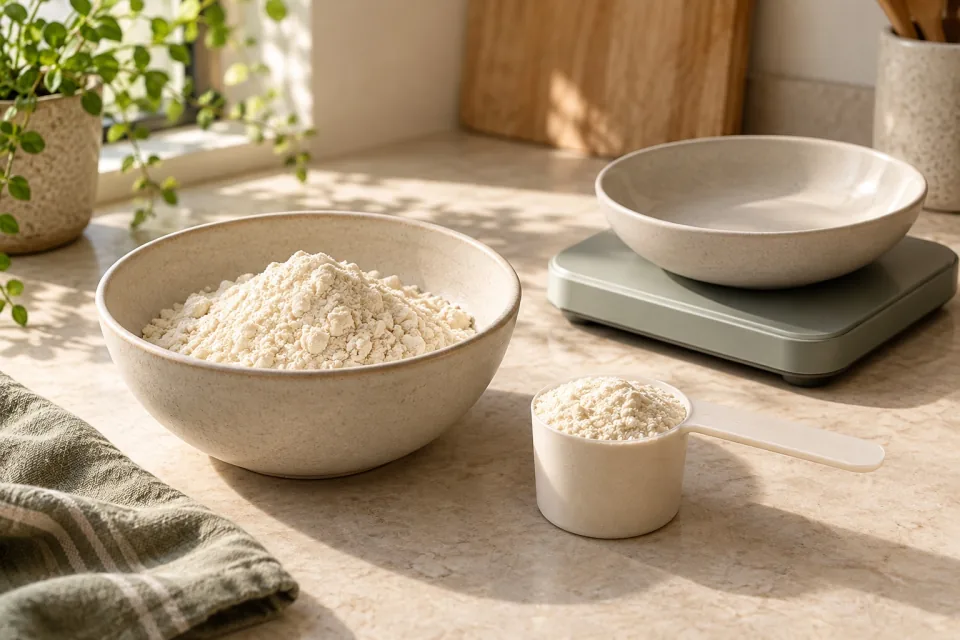
A scoop measures space, while a scale measures powder mass
A scoop's capacity, the mass of powder it holds and the protein declared for a serving describe different things. Confusing them makes it easy to attribute the label's protein information to a scoop without checking how much powder that scoop contains.
Capacity is the space available inside a container. Powder mass is the amount of powder measured by weight, usually expressed in grams on a kitchen scale. Protein is a nutrient within that powder, so the powder's total mass and its declared protein content belong to separate parts of the measurement.
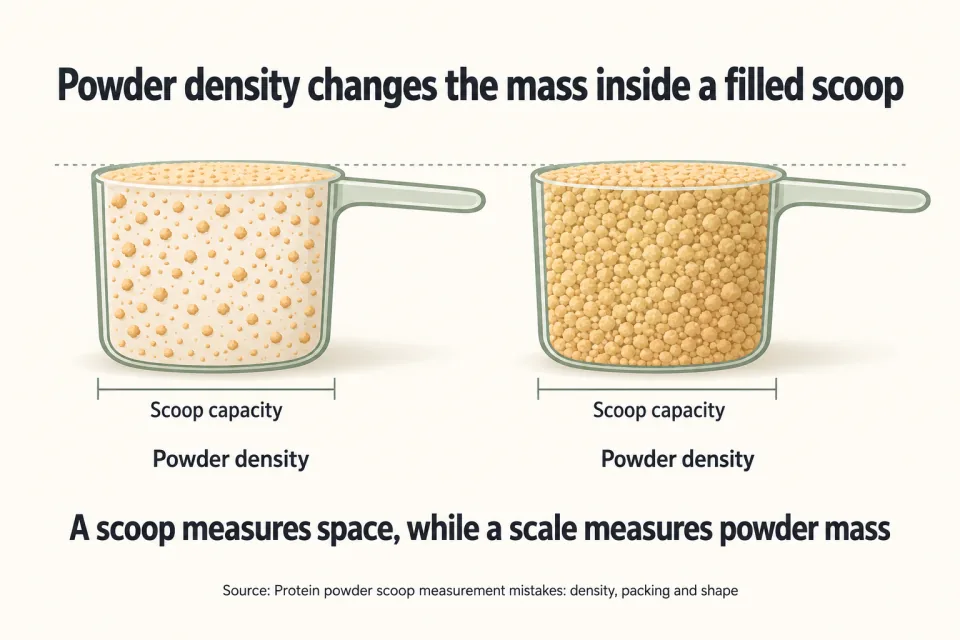
A scoop therefore answers a question about volume: how much space has been filled? A scale answers a question about mass: how much does the powder weigh? Connecting those measurements requires the powder's bulk density, which means its mass per unit of occupied space, including the spaces between particles.
The serving declaration supplies another connection. On a U.S. Nutrition Facts label, the serving information appears near the top and pairs a household measure with a metric amount. The nutrient information usually refers to that declared serving, although some labels also show information for the whole package.
Read the household measure and metric amount together when interpreting a scoop description. The household measure describes the portion in familiar terms; the metric amount gives its stated mass or volume. The protein entry is separate nutrient information associated with the serving described on that label.
For example, a scoop filled to its rim establishes a visible boundary for the powder. It does not, by itself, establish the powder's mass. Reading the protein entry beside a serving description adds information about that declared serving, but it does not turn the scoop into a weighing tool.
The FDA explains that a labelled serving size is not a recommendation of how much to eat or drink. Here, the serving is a reference for understanding the label and the measurement. Keeping that role clear allows the scoop and scale to be discussed without turning either into an intake instruction.
Powder density changes the mass inside a filled scoop
Powders can occupy the same volume while having different masses because their bulk densities differ. The shape of their particles and the way those particles settle help explain why a scoop's capacity cannot stand in for a powder's weight.
ADPI's powder measurement method distinguishes loose bulk density from packed bulk density. Loose density describes powder measured without deliberate settling or compaction. Packed or tapped density describes powder after mechanical settling, which increases the mass contained within a given volume.
This distinction applies even when the measuring container stays the same. A loose fill and a settled fill represent different measurement conditions. The boundary of the container may be unchanged, while the amount of powder within that boundary differs because of how the powder occupies the space.
Particle structure provides another part of the explanation. In research from Wageningen University & Research in the Netherlands, maltodextrin powders had more wrinkled particles and high bulk density, while pure whey-protein powders had more hollow particles. Maltodextrin and whey protein were materials examined in that study; the findings describe those materials under the conditions tested.
The same research connected drying conditions with the resulting powder structure. For the whey-protein and maltodextrin mixture examined, a higher drying inlet temperature led to more hollow particles and lower bulk density. The researchers also found that faster pilot-scale drying affected particle shape differently from slower drying of individual droplets.
Storage and packaging were part of a separate dairy-powder study at California Polytechnic State University in the United States. That study found differences between powder types in bulk density, tapped density and compressibility, meaning how readily the powder could be compacted. Under its experimental conditions, bulk and tapped density increased during storage.
The California study also reported that vacuum packaging increased density by removing air between particles. These findings explain why both the material and its handling belong in an account of powder measurement. They describe particular dairy powders and experimental conditions, so their application here is to explain sources of variation rather than assign a fixed weight to an unspecified scoop.
Levelling and packing change different parts of the measurement
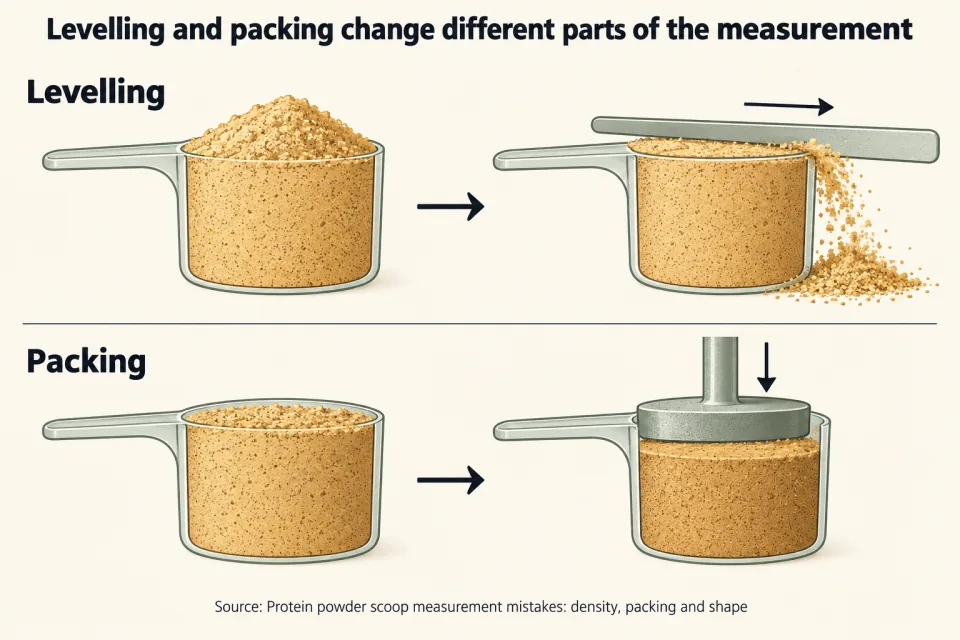
Levelling establishes the top boundary of a dry measure, while packing changes how tightly the material fills it. A level surface therefore describes the finish of the measurement without fully describing the way the powder was placed inside.
Mississippi State University Extension in the United States explains levelling as scraping excess dry ingredient away with a flat edge across the cup's rim. This gives the measurement a defined endpoint. A heap above the rim uses a different endpoint, so a heaped fill and a level fill describe different volumes.
The distinction between filling and packing is clear in the extension's kitchen examples. Its flour method involves spooning flour into the measuring cup without packing it. Its brown-sugar instructions distinguish lightly packed from firmly packed measurements according to how strongly the ingredient is pressed into the cup.
Those examples show why a measuring instruction needs more than the name of the utensil. The filling method is part of what the measurement means. They illustrate the language of dry measurement; their ingredient quantities do not supply a conversion for protein powder.
ADPI's laboratory method makes a similar distinction through its equipment and procedure. It includes a spoon for gentle powder transfer and a straightedge for bringing the powder surface level with the measuring cylinder's rim. Deliberate settling belongs to the separate packed-density measurement.
For a practical comparison of scoop fills, describe the filling action as well as the surface. Powder gently transferred and levelled has been handled differently from powder deliberately pressed down and then levelled. Both surfaces can meet the rim, yet the descriptions still identify different packing conditions.
A useful measurement note would therefore record whether the powder was transferred gently, deliberately settled or pressed into place, and whether its surface was level or heaped. This separates the actions that change packing from the action that sets the upper boundary. ADPI's method identifies controlled measurement conditions as a way to improve consistency.
Scoop shape matters because capacity depends on the whole container
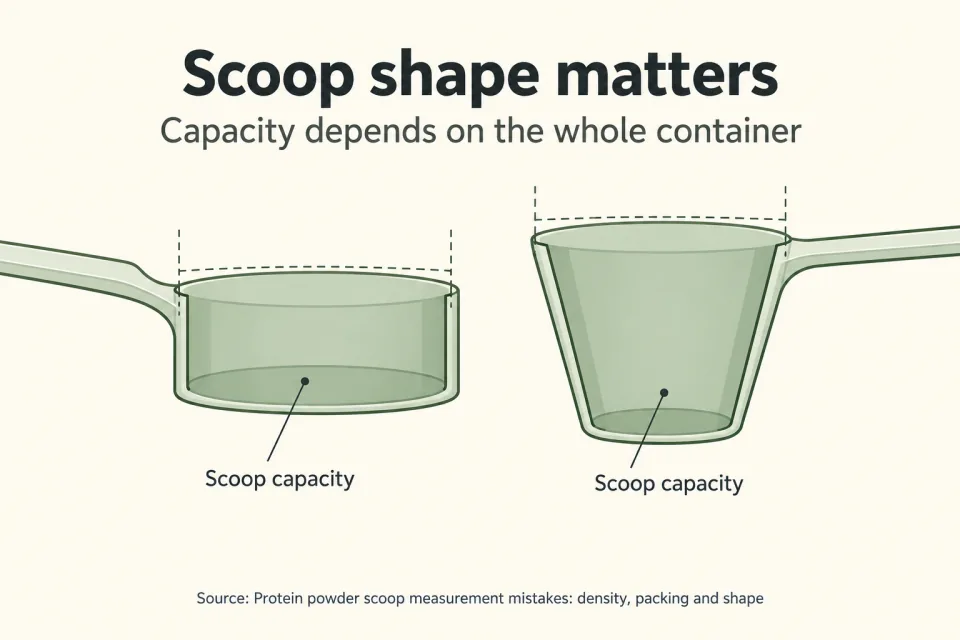
A scoop's capacity depends on its internal shape, so its height alone does not describe how much it holds. The National Institute of Standards and Technology, or NIST, in the United States uses different capacity calculations for cylindrical and sloping-sided containers.
For a cylinder, both diameter and height enter the calculation. For a container with sloping sides, NIST's approximate method uses vertical height together with the areas at the top and bottom. These distinctions explain why comparing scoop depth without considering width and taper leaves out part of the capacity calculation.
A mark partway up a scoop describes a height. Interpreting that mark as a volume requires the shape of the space beneath it. With sloping sides, the top and bottom areas differ, which is why NIST's capacity method includes both rather than using height alone.
NIST also describes a kitchen method for estimating a vessel's capacity using water. The empty vessel is placed on a scale and tared, then filled with water to the rim and weighed. This estimates the vessel's volume through water's density; it answers a question about the container's capacity.
Powder weight remains an ingredient-specific question. A capacity estimate made with water describes the space available inside the vessel. Connecting that space with a mass of powder requires information about the powder, including the packing conditions used for the measurement.
The units printed on measuring tools can clarify which question they answer. NIST distinguishes an ounce, a mass unit, from a fluid ounce, a volume unit. It also explains that litres and millilitres can describe dry volume as well as liquid volume, so a volume marking does not automatically identify a weight.
International terminology adds another source of confusion. NIST notes that customary measures such as teaspoons and cups can represent different quantities in different countries. NIST recommends establishing an ingredient's conversion from a customary volume measure to grams by measuring that ingredient and then weighing it. The ingredient-specific measurement connects the utensil's capacity with the material it actually holds.
Taring separates the powder from the container
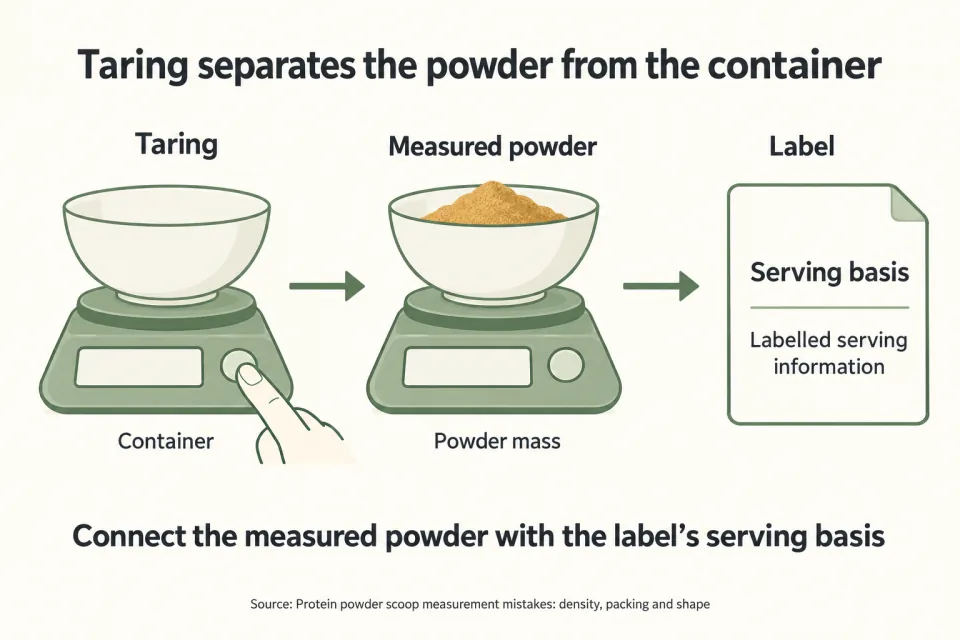
Taring a kitchen scale removes the container's weight from the displayed reading, allowing the powder to be measured separately. NIST describes ingredient measurements by weight as more precise and consistent than measurements by volume.
Begin the measurement with the empty container on the scale, then use the tare function. Add the powder portion being examined and read its mass. This sequence measures the powder placed in the container; it does not recommend an amount to use or require changing that portion to match a serving declaration.
The order matters because taring excludes what is already on the scale. If the empty container is tared, the subsequent display refers to what is added afterward. Reading the container and powder together without that step includes the container in the displayed weight.
When the question concerns a scoop, use the scoop to transfer the powder into the tared container. Keep the filling description alongside the reading: level, heaped, gently filled or deliberately packed. The scale provides the mass, while the description preserves the conditions that led to that mass.
For an explanatory comparison, the same scoop can be examined after gentle filling and after deliberate settling. Weigh each fill separately in a tared container and keep the conditions identifiable. This follows the distinction between loose and packed measurement without assuming a particular difference in advance.
NIST also explains that a scale can be tared again after an ingredient has been added, allowing the next ingredient to be measured separately. In a mixture, that means the displayed addition can be distinguished from the ingredients already in the container. The reading after another tare refers to the new addition, rather than the combined mass of the mixture.
The total load relevant to scale capacity still includes the container and all its contents. Taring changes the displayed measurement but leaves those items on the scale. NIST advises removing the bowl from the scale before mixing its contents. After the weighing stage, the recorded powder mass can be compared with the serving declaration as a separate label-reading task.
Connect the measured powder with the label's serving basis
The powder's measured mass can be connected with the label only after identifying the serving basis for its nutrient information. On U.S. Nutrition Facts labels, that basis is usually a serving, but some labels also include information for the entire package.
Start by locating the serving declaration and its metric amount. Then identify which column contains the nutrient information being read. A package may hold multiple labelled servings, so information for a serving and information for the package describe different amounts of food.
The FDA explains proportional interpretation of nutrient information: a portion containing more or fewer labelled servings corresponds to proportionally different listed nutrient quantities. Applied to powder measurement, this means the relationship depends on the amount of powder represented by the serving declaration. The fact that a scoop was used does not establish that relationship on its own.
Consider how the interpretation changes when each part is recorded separately. The scoop description identifies the utensil and how it was filled. The scale reading gives the mass of that fill, and the label identifies the mass associated with its declared serving. Together, these allow the measured portion to be related to the serving information without assigning the scoop a universal weight.
The distinction also clarifies what a level scoop establishes. Levelling gives a repeatable surface boundary, but the powder inside can still have different packing conditions. A weighing step adds the mass information that the visible boundary alone does not provide.
A household spoon substitution raises a related question about capacity. The spoon's name refers to a volume measure, and customary measures can vary between countries. Even after the volume is identified, the powder-specific link between volume and mass remains necessary before relating that spoonful to the label's serving mass.
The most useful record keeps capacity, filling method, measured powder mass and the serving declaration separate. Each answers a different measurement question, and each has a source in either the utensil, the weighing process or the label. Protein information belongs with the amount of powder the label describes; a scoop's appearance supplies only part of that explanation.
From the journal's records
No writer is named: the essay is credited to the journal, Protein Networks.
It cites 9 sources.
Notes
Works consulted
- Analytical Method #012: Determination of Powder Bulk Density
- Metric Kitchen: Cookware and Tools
- Serving Size on the Nutrition Facts Label
- Measuring Dry or Solid Ingredients
- Particle morphology and powder properties during spray drying of maltodextrin and whey protein mixtures
- Evaluation of Vacuum Packaging on the Physical Properties, Solubility, and Storage Space of Dairy Powders
- Approximate Conversions from U.S. Customary Measures to Metric
- Metric Kitchen: Culinary Measurement Tips
- Circumference, Area and Volume