 Protein Networks
- Protein Networks
- How protein guidance accounts for plant-based diets
An essay
How protein guidance accounts for plant-based diets
Plant protein was included in the evidence behind adult protein guidance. Understand the population context, mixed-diet assumptions and differences between protein quantity, amino acid composition and digestibility.
The journal's automated checks of this essay's content and sources passed on , and this version appeared after they did. Read the health disclaimer.
In this essay
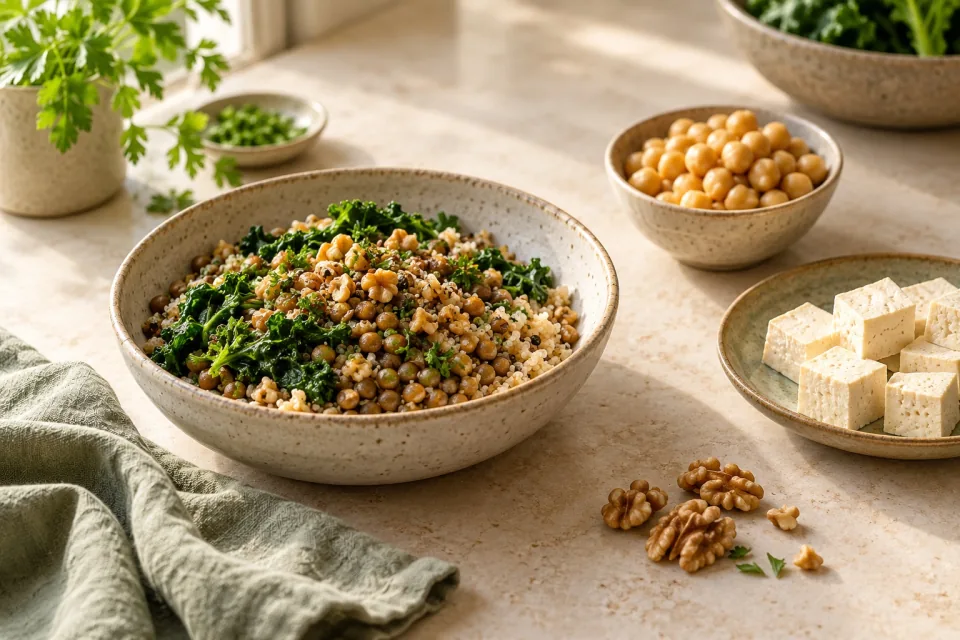
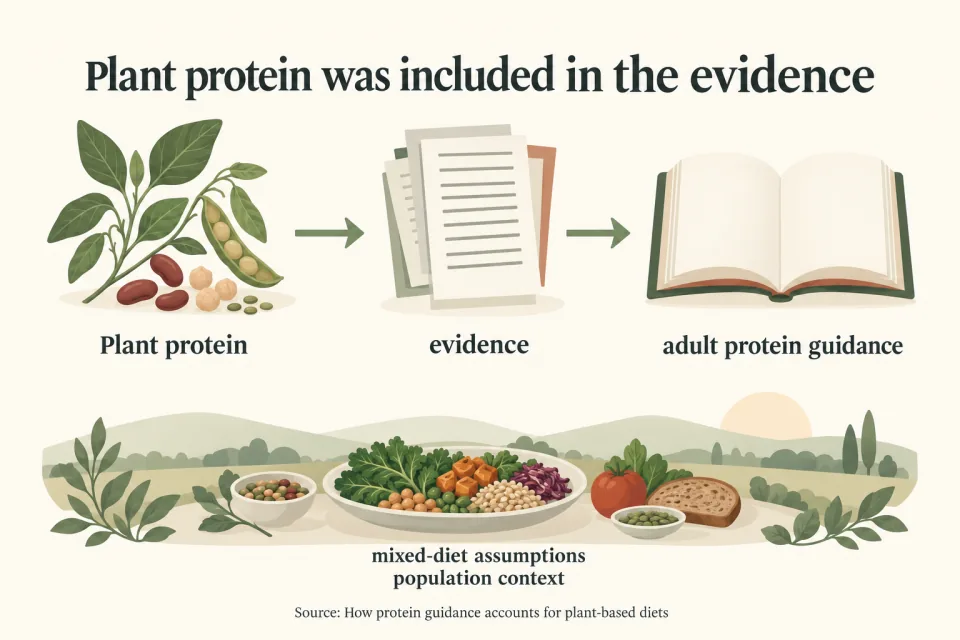
Plant protein was included in the evidence
EFSA, the European Food Safety Authority, considered plant protein when developing its adult protein reference values, but its supporting analysis could not establish separate requirements according to protein source. That distinction explains why including plant-based diets in the evidence is different from setting guidance specifically for vegan adults.
EFSA based its adult values on nitrogen-balance evidence. Nitrogen balance is an accounting approach that compares nitrogen entering and leaving the body. EFSA defined adult maintenance requirements through nitrogen equilibrium under conditions of energy balance. This describes the conditions used to establish a reference value; it does not describe the food choices within every possible diet.
The supporting analysis grouped diets according to whether their protein came mainly from animal foods, mainly from plant foods, or a mixture. Plant protein was therefore an explicit part of the comparison. The grouping also matters: a diet classified as predominantly vegetable protein is not necessarily identical to a vegan diet, which excludes foods of animal origin. The evidence categories and the everyday diet labels answer related but different questions.
The analysis had insufficient statistical power to establish separate adult requirements for those protein-source groups. Statistical power concerns an analysis's ability to distinguish a difference from the variation in its evidence. This limitation means that the lack of separate values does not prove that all protein sources are interchangeable. It also does not, by itself, establish how any particular plant-based eating pattern compares with the diets represented in the analysis.
The useful reading is therefore conditional. EFSA's adult reference intake applies to high-quality protein and usual European mixed diets expected to supply sufficient indispensable amino acids. Amino acids are the components of proteins, and the indispensable ones must come from food because the body cannot make enough of them. The quality assumption belongs alongside the reference value whenever the guidance is explained. Removing that assumption makes the guidance appear broader than the statement EFSA actually made.
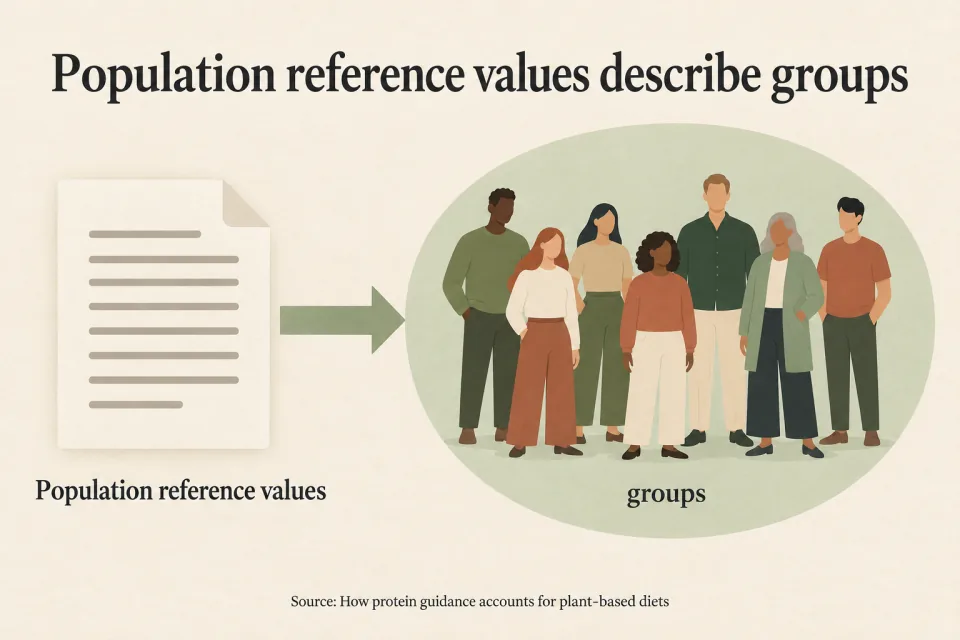
Population reference values describe groups
Dietary reference values describe the needs of population groups rather than set an intake for an individual. EUFIC, the European Food Information Council, explains that different reference values have different roles in assessing and planning diets. Understanding those roles helps separate the meaning of the guidance from questions about particular foods.
An Average Requirement describes the middle of the requirement distribution within a specified group. A Population Reference Intake is intended to cover the requirements of almost everyone in that group. These terms refer to different positions within a distribution, so they cannot be read as alternative names for the same thing. The population being described is part of the meaning of each term.
An Adequate Intake is used when the evidence is insufficient to establish an Average Requirement and a Population Reference Intake. Its name does not mean that it is a more ambitious version of the other values. It reflects a different evidential situation. Reading the label attached to a reference value is therefore as important as identifying the nutrient to which it refers.
Food-based dietary guidelines perform a further task: they translate nutrient reference values into practical eating guidance. A nutrient reference can describe protein at the population level without specifying whether a meal contains beans, eggs, tofu or fish. Guidance about food choices has to connect that nutrient framework with the foods included in an eating pattern. A reference value alone does not make those choices.
For the plant-based question, it helps to keep the population and the diet separate. The population tells us whom the reference describes, while the dietary assumptions tell us what kind of protein supply the statement anticipates. Calling a value an adult reference does not erase its assumptions about quality. Equally, naming a diet vegetarian or vegan does not turn a population reference into a personal calculation. The question is how the foods in that pattern relate to the conditions attached to the guidance.
The mixed-diet assumption has a specific context
EFSA's reference to usual European mixed diets describes a dietary context that includes plant and animal protein. It is more specific than saying that the guidance applies to any collection of foods. For readers elsewhere, the relevant comparison is the composition of the diet, rather than whether its meals resemble European meals.
The European Commission's dietary overview identifies meat, grain-based foods and dairy foods as the main protein-contributing groups in the European data it summarises. Grain-based foods are therefore part of the background to the mixed-diet assumption. Reading that assumption as a reference only to animal protein would leave out a food group that the overview identifies as a main contributor.
The Commission attributes the generally high protein quality of Western diets to varied plant foods together with substantial contributions from animal foods. This explains why the word mixed carries meaning. The assumption concerns the combined protein supply of the diet, including the amino acid contributions of different foods. It does not establish that every food within that diet has the same composition or quality.
Diet labels help describe which sources are available, but they need definitions. A lacto-ovo-vegetarian diet includes dairy foods and eggs. A vegan diet excludes foods of animal origin. A vegetarian pattern containing eggs and dairy foods therefore differs from a vegan pattern in the protein sources it can include. Neither label, on its own, describes how much each included food contributes to the overall diet.
International examples can make that distinction easier to follow. Dal with rice in an Indian meal and beans served with a grain can be considered through the cereal-and-legume framework, rather than through their resemblance to a European menu. The question is which food groups contribute protein and how their amino acid profiles fit together. The same approach can describe a pattern containing tofu, or a vegetarian pattern that also contains yogurt and eggs.
The European dietary data also require care when comparing countries. The Commission notes that differences in survey methods and age categories complicate direct comparisons of protein intakes. Those data explain the setting behind the guidance, but they are not a precise template for an international reader's meals. Dietary composition gives the more useful connection between the population context and a particular eating pattern.
Protein quantity and quality describe different things
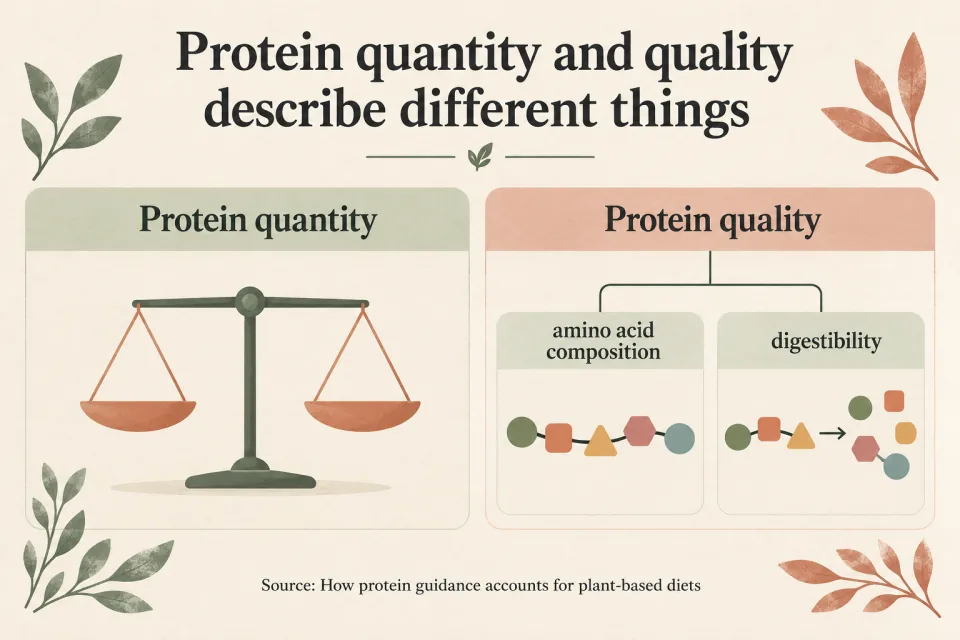
Protein quantity describes how much protein a food contains, while protein quality considers its amino acid composition and digestibility. Digestibility concerns how much of the protein can be broken down and absorbed. Keeping these concepts separate explains why a protein amount alone cannot answer every question about a plant-based diet.
The Food and Agriculture Organization of the United Nations explains that food-composition tables commonly estimate protein by measuring nitrogen and applying a conversion factor. This produces an estimate of protein content. It does not, by itself, describe the balance of amino acids within that protein. A food's protein amount and its amino acid profile are related pieces of information, but they are not the same measurement.
Amino acid scoring compares the protein in a food or mixture with a reference pattern of amino acid requirements. The comparison asks how the amino acid composition fits that reference. Foods of plant and animal origin vary widely in protein content and amino acid composition, according to the European Commission. The broad source category is therefore only a starting description of a food's protein.
Digestibility adds another part of the assessment. Traditional measurements compare nitrogen in food with nitrogen excreted in faeces. The FAO chapter explains that food structure, dietary fibre, polyphenols and chemical changes affecting amino acid release can influence protein digestibility. This is why quality assessment involves more than identifying the amino acids present in a food.
EFSA describes PDCAAS as an amino acid score adjusted for protein digestibility. The abbreviation names a method that brings the amino acid comparison and digestibility together. Its result concerns protein quality within that method. It is not an overall ranking of a food's other nutrients or calories, which are separate aspects of its composition.
EFSA did not establish separate dietary reference values for indispensable amino acids, citing imprecise evidence and their usual consumption within proteins. That decision should be read alongside the opinion's discussion of amino acid scoring. The absence of separate amino acid values does not remove amino acid composition from protein-quality assessment. It reflects the distinction between discussing a component of quality and having enough evidence to assign that component its own population reference.
The whole diet can differ from its individual foods
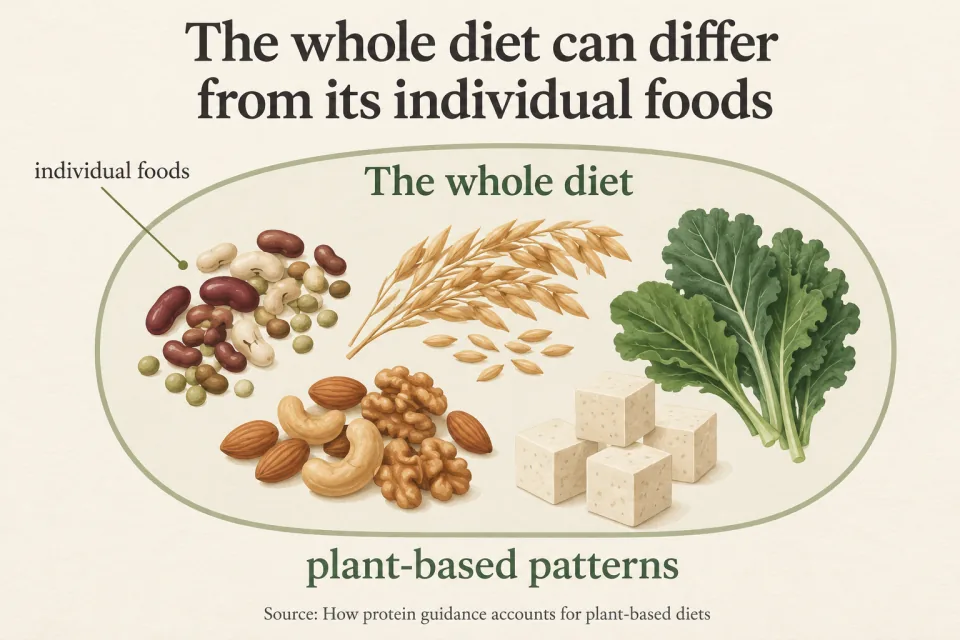
A varied diet can combine plant proteins with different amino acid profiles, so assessing the whole diet can give a different picture from judging its foods separately. EFSA describes PDCAAS as applicable to individual foods and whole diets. The level of assessment matters when interpreting a statement about protein quality.
The European Commission explains that cereal proteins are relatively low in lysine, an indispensable amino acid. Sulphur-containing amino acids can limit the quality of legume proteins. These are different aspects of their amino acid profiles. The Commission describes how different plant proteins can complement each other within a varied diet, which connects the cereal-and-legume example to whole-diet assessment.
Dal and rice provide a way to think through that explanation without assigning a score to the plate. The cereal-and-legume framework directs attention to the combined amino acid profile. Beans with a grain provide another example of the same question. These examples illustrate the assessment method; they do not establish the protein content or quality score of a particular recipe.
The FAO chapter describes a whole-diet digestibility estimate that weights each food's digestibility according to its contribution to dietary protein. A food contributing more of the protein has more influence on that calculation. Simply counting the foods on a plate would answer a different question. Variety names the range of foods present, while weighting also considers their respective protein contributions.
This helps explain why a varied plant-based pattern cannot be assessed merely by collecting isolated food scores. The amino acid composition of the mixture and the protein contribution from each source both matter to the assessment described in the research. A statement about a cereal alone leaves out what a legume contributes alongside it. Conversely, naming a complementary pairing does not supply all the information needed to calculate its quality.
EUFIC's discussion of plant protein includes pulses, whole grains, nuts, seeds and soy foods as sources of variety across the day. That gives the whole-diet idea a broader setting than a single plate. A breakfast food, a bean dish and a soy food can be considered as parts of the eating pattern being assessed. The framework concerns the combined supply across that pattern, rather than requiring every food to have an identical amino acid profile.
Food choices connect plant-based patterns with the guidance
Applying the dietary assumptions starts with identifying the foods that supply protein within the pattern. EUFIC states that a plant-based diet can provide sufficient protein, although planning may be needed. That statement leaves room to examine the actual food choices instead of assuming that a plant-based label describes their protein contribution.
Consider a meal being changed from a meat-containing dish to a plant-based dish. EUFIC explains that replacing meat calls for choosing plant foods rich in protein, rather than assuming that any vegetable dish or salad provides an equivalent replacement. This is a question about the food's contribution to the meal. The absence of meat describes an exclusion; identifying the replacement describes the new protein source.
A further comparison can distinguish plant foods by their ingredients. Tofu and tempeh are made from soy, while seitan is made from wheat protein. EUFIC identifies soy as a source of high-quality plant protein. These descriptions show why tofu and seitan should be identified by their source ingredients when discussing protein: grouping them together as plant foods leaves out information relevant to their composition.
The same reading method works for vegetarian patterns that include eggs and dairy foods. Record those foods as part of the pattern rather than treating vegetarian as another word for vegan. Then distinguish the sources present from the amount of protein they contribute and from the quality of the combined protein. Each question adds information that the diet label alone does not supply.
When reading a published reference, begin with the named population and the type of reference value. Next, read the statement about dietary protein quality and identify whether it concerns a food or a whole diet. Finally, compare those assumptions with the food sources described in the eating pattern. This sequence connects the population guidance to its dietary context without turning it into a personal target or inventing an adjustment for vegan diets.
Notes
Works consulted
- Scientific Opinion on Dietary Reference Values for protein
- Dietary Protein
- What are dietary reference values (DRVs) used for in nutrition?
- Plant-based protein: all you need to know to get enough of it
- What’s Important for Vegetarians and Vegans to Eat?
- Energy and protein requirements: Factors affecting energy and protein requirements
From the journal's records
No writer is named: the essay is credited to the journal, Protein Networks.
It cites 6 sources.