 Protein Networks
- Protein Networks
- Egg white protein, albumin and ovalbumin explained
An essay
Egg white protein, albumin and ovalbumin explained
Learn how albumen, albumin and ovalbumin differ, why egg white contains several proteins, and how their structures explain setting during cooking and forming foam during whipping.
The journal's automated checks of this essay's content and sources passed on , and this version appeared after they did. Read the health disclaimer.
In this essay
Egg white protein and albumin are not exact synonyms
Egg white protein is a mixture of proteins, while albumin is a broad protein term and ovalbumin names a particular protein in that mixture. The similar spelling can obscure these distinctions. Albumen, with an e near the end, primarily means the white of an egg.
These names describe different things. Albumen names the part of the food surrounding the yolk. Egg white protein refers collectively to the proteins within that part. Ovalbumin identifies a particular member of that collection, rather than the whole egg white or all its protein together.
Albumin has a wider meaning. Merriam-Webster uses it for numerous proteins that dissolve in water and coagulate when heated. Coagulation is the joining together of proteins as they set. The dictionary also places albumins in milk and plant tissues, so the word does not identify egg white alone.
There is some overlap in ordinary usage: Merriam-Webster records albumin as a secondary meaning of albumen. That helps explain why the terms sometimes appear interchangeable in descriptions of eggs. A dictionary can record overlapping usage while a chemistry explanation still needs to distinguish the whole white from its constituent proteins.
Consider how the meaning changes across familiar phrases. In a description of egg anatomy, albumen points to the white as a whole. In a discussion of water-soluble proteins, albumin names a broader category. In a description of a particular egg-white protein's structure, ovalbumin is the specific name. The surrounding sentence therefore matters as much as the spelling.
For clear writing about food, use egg white or albumen for the whole white, egg-white proteins for the mixture, and ovalbumin when discussing that particular protein. This vocabulary preserves the difference between a food component and the molecules it contains. It also leaves room to explain why the proteins within egg white behave differently when heated or beaten.
Albumen includes water and a physical arrangement
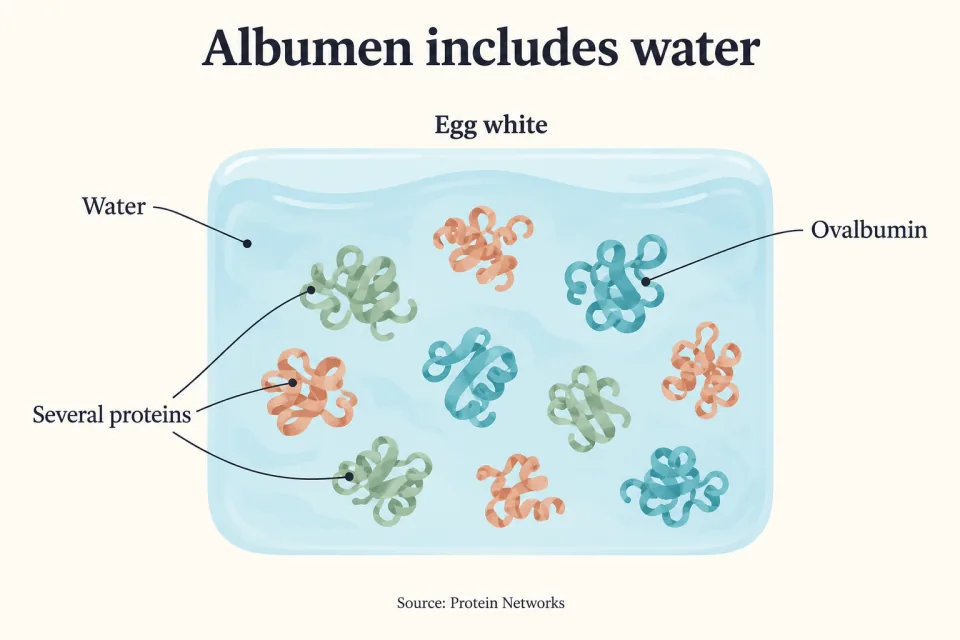
Albumen contains numerous proteins dispersed in water, arranged in regions with different thicknesses. It is a food mixture with a visible organization as well as a molecular composition. Calling it simply albumin leaves both aspects unclear.
The Exploratorium describes four alternating layers of thick and thin albumen. This means that the white surrounding a yolk is not uniform in consistency. The distinction between thick and thin white belongs to the anatomy of the egg; it does not divide the white into separate portions of pure protein.
The opaque strands near the yolk are also egg white. Called chalazae, these ropes hold the yolk near the egg's center. The Exploratorium describes them as connections between the yolk's casing and the membrane lining the eggshell. Their rope-like appearance is part of the physical organization of the white.
The yolk's clear casing has a separate name, the vitelline membrane. Keeping these names apart helps when reading an egg diagram: the casing surrounds the yolk, while the chalazae connect it to the shell's inner membrane. Albumen refers to the white around this arrangement, including its thicker and thinner regions.
At the molecular level, the composition account hosted by Conservation OnLine identifies ovomucin as a contributor to the thickness of egg white. This connects a named protein with a property visible in the food. Thickness therefore offers a useful example of why the identity of a constituent protein matters, beyond knowing that egg white contains protein.
The anatomy and the chemistry answer different questions. Thick layers, thin layers and chalazae describe how the white is arranged around the yolk. Ovalbumin, ovomucin and the other protein names describe substances within the white. Neither a visible strand nor a thick region should be read as a separate sample of ovalbumin merely because it is made of egg white.
A protein's chain and its folded shape are different
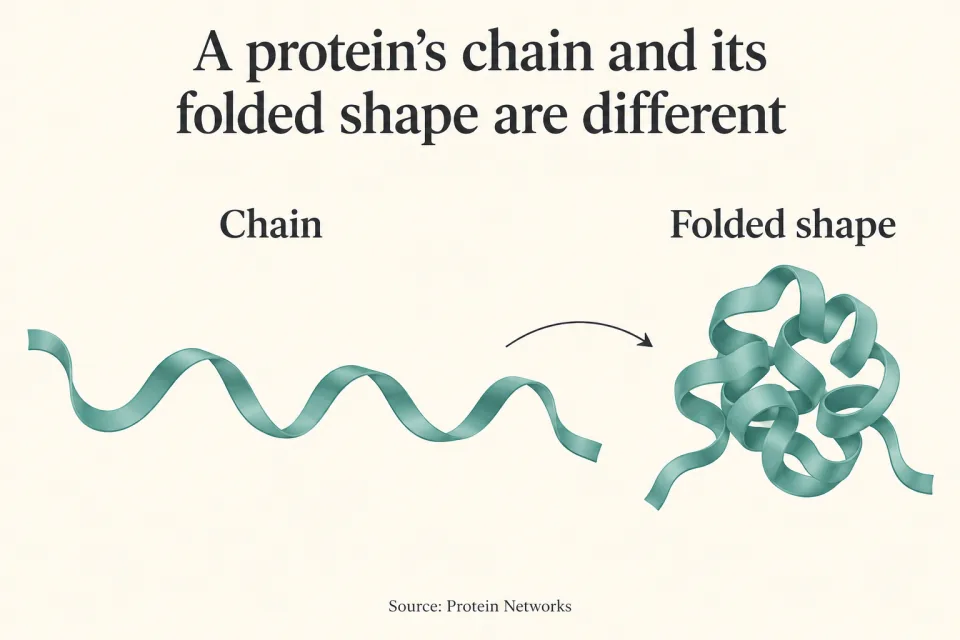
A protein has an amino-acid sequence and a folded shape, and changing the shape does not necessarily break the sequence apart. This distinction explains what happens when egg-white proteins undergo denaturation, the change in shape associated with heating or beating.
Amino acids are the building units connected in a protein chain. The links between them are called peptide bonds. The order of those amino acids is part of the protein's primary structure. Here, primary structure means the sequence within the chain, rather than the outward shape into which that chain folds.
Conformation is the term for a protein's shape in space. A description of conformation asks how the chain is folded and arranged. A description of sequence asks which amino acids follow which. These are related descriptions of a protein, but they provide different information about it.
The protein chemistry account hosted by Conservation OnLine explains that denaturation generally changes conformation while leaving peptide bonds and primary structure intact. In plain language, a protein can lose its original folded shape while its amino-acid chain remains connected. Denaturation therefore does not mean that the protein has disappeared from the food.
Heating egg white provides a concrete example. According to the Exploratorium, heat disrupts weak bonds that help maintain the proteins' folded shapes. The proteins can then unfold. Those weak bonds holding a fold in place are distinct from the peptide bonds linking amino acids along the chain.
This difference also clarifies the relationship between unfolding and setting. Unfolding describes a change within the shape of a protein. Setting involves unfolded proteins connecting into a network throughout the white. A cooking explanation becomes more precise when it distinguishes the change in individual molecules from the formation of a network across the food.
The same vocabulary can describe beating as well as heating because mechanical action can also change protein structure. The resulting arrangement depends on what happens around the proteins: a cooked white contains a network holding water, while a whipped white contains protein networks around incorporated air. The change in shape helps explain both outcomes without making them identical processes.
The proteins in egg white have different properties
Ovalbumin is the major egg-white protein, but the mixture also contains proteins with different structures, solubility and responses to heat. The RCSB Protein Data Bank identifies ovalbumin as the major protein. The composition account hosted by Conservation OnLine names conalbumin, ovomucoid, lysozyme, globulins and ovomucin alongside it.
Being the major protein does not make ovalbumin a name for the entire mixture. Its own behavior is also only part of the explanation for how egg white changes. For example, the composition account describes conalbumin as more sensitive to heat than ovalbumin. It also describes ovalbumin as susceptible to denaturation through mechanical action.
Ovomucoid provides a different comparison because its response to heat depends on the surrounding conditions. It resists heat denaturation under acidic conditions but can denature with heat under more alkaline conditions. The relevant distinction is therefore both which protein is present and the conditions in which it is heated.
Solubility offers another way to separate the terms. Solubility describes whether a substance dissolves in a liquid. Albumins dissolve in water, whereas globulins generally do not dissolve in water alone but do dissolve in mild salt solutions. Since egg white contains globulins as well as other proteins, calling the whole protein mixture albumin conceals a meaningful difference.
The RCSB record describes ovotransferrin as folding into two related lobes. Each lobe contains two domains, or structural regions, according to RCSB. In the iron-loaded structure, an iron ion and a carbonate ion bind in a cleft between the domains of each lobe. This is a description of a particular protein's structure, distinct from the general appearance of egg white.
Lysozyme has another identifiable shape. RCSB PDB-101 describes an elongated groove that binds a carbohydrate chain. Ovomucin, meanwhile, contributes to the white's thickness. These details connect protein names with specific properties instead of leaving them as an unexplained collection of unfamiliar words.
Taken together, the comparisons show why egg-white protein is best understood as a mixture. The individual proteins differ in how they dissolve, how they fold and how readily their shapes change under particular conditions. Ovalbumin is central to that mixture, but its name cannot describe all those constituents accurately.
Cooking makes a network that holds water
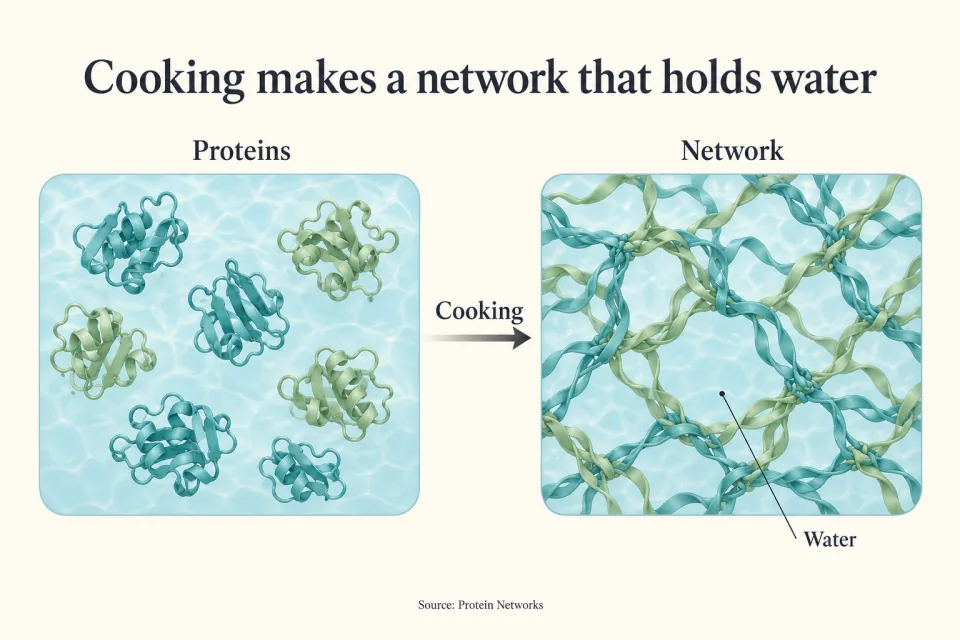
Egg white sets during cooking because unfolded proteins connect into a network that holds water. The Exploratorium describes this network as a gel. The change from liquid white to set white therefore involves both protein connections and the water held between them.
The process begins with changes to folded proteins. Heat disrupts weak bonds maintaining their shapes, allowing them to unfold. As the proteins connect, the developing network extends through the white. Coagulation names this joining and setting, while denaturation describes the preceding changes in protein shape.
Water remains part of the explanation after the white has set. A gel contains water held within its network, so a firm white is still a mixture. Its solid appearance does not mean that cooking has separated out pure ovalbumin. The water and the connected proteins together account for the form described by the cooking source.
Excessive heat or cooking time can cause extra protein bonds to form, forcing water out and giving egg white a rubbery texture, according to the Exploratorium. That texture change follows from a change in the network. The distinction between a set white and a rubbery white is therefore more specific than simply saying that both have been cooked.
Salt can also change setting behavior. The Exploratorium reports that egg white solidifies faster in hot salted water than in hot fresh water. This comparison shows that the surrounding liquid matters alongside heat. A description based only on a protein's name would leave out a condition that changes how the white sets.
The different heat responses of the constituent proteins add another layer to the explanation. Conalbumin's greater heat sensitivity and ovomucoid's dependence on acidic or alkaline conditions mean that the mixture's behavior cannot be reduced to a uniform response from ovalbumin alone. The visible result belongs to the whole white, even though its proteins have distinct properties.
For understanding a cooking description, follow the sequence from folded proteins to unfolding, then to connections and a water-holding gel. Each stage answers a different question about the change in texture. This sequence gives the word protein a concrete meaning in the food without suggesting that egg white is a single substance.
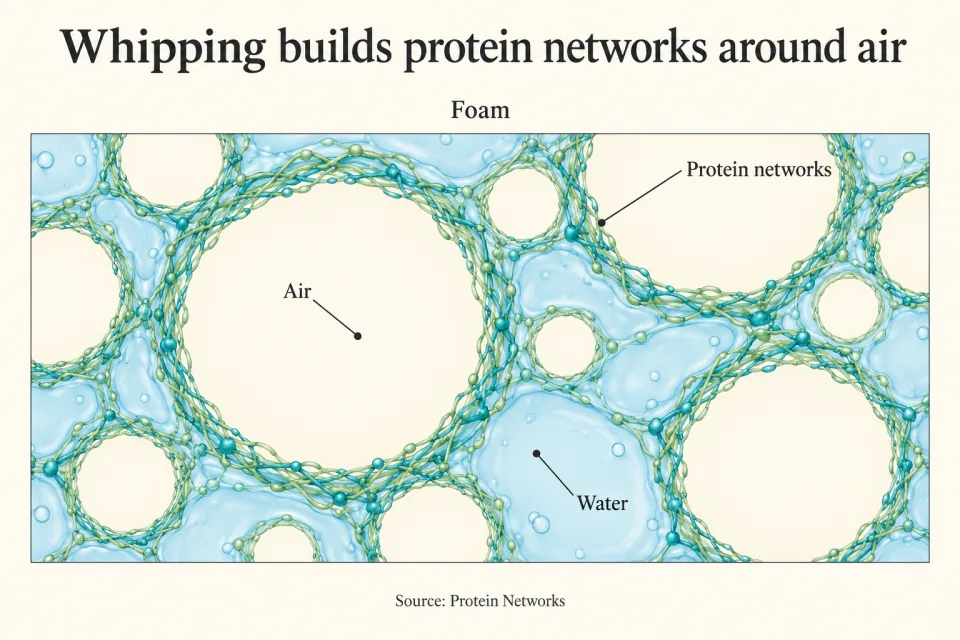
Whipping builds protein networks around air
Whipping changes egg-white protein structure while incorporating air, allowing proteins to form networks around bubbles. The resulting foam depends on both processes. Beating is therefore more than stirring air into an unchanged liquid.
The Exploratorium explains that egg proteins contain amino-acid regions with different relationships to water. Some regions are water-attracting, while others are water-repelling. When whipping unfolds the proteins, these regions can take different positions around the boundary between the liquid white and the incorporated air.
Water-attracting regions remain in the liquid, while water-repelling regions face the air. The rearranged proteins then bond into a network around the bubbles. This arrangement explains how protein structure contributes to holding the air in place, rather than treating foam as a separate substance added to the white.
At the soft-peak stage, the Exploratorium describes the proteins as partly denatured and still retaining some elasticity. This links a named stage of whipping to a change at the molecular level. The proteins have altered their shapes, but the network still has some ability to stretch.
Heating a whipped white adds a further change. The protein walls around the air bubbles set, helping create the light texture of meringues and soufflés. Whipping establishes the arrangement around air; heating sets those surrounding walls. The explanation needs both the introduced bubbles and the proteins that hold them.
Compare this with a white set by cooking without whipping. In the cooking account, proteins connect into a gel that holds water. In the whipping account, proteins rearrange around air bubbles within the liquid. Both involve changes in protein shape and new connections, but the surrounding arrangement explains the different textures.
These examples also make the terminology easier to read in context. Albumen names the egg white being beaten or heated. Egg-white proteins names the mixture whose shapes and connections change. Ovalbumin names a particular protein within that mixture, while albumin retains its broader meaning. Keeping those levels separate allows a description of cooking to be precise about both the ingredient and the molecules involved.
Notes
Works consulted
- Albumen Definition & Meaning
- Albumin Definition & Meaning
- Science of Eggs: Anatomy of an Egg
- Protein Chemistry of Albumen Photographs
- 1OVA: Crystal Structure of Uncleaved Ovalbumin at 1.95 Angstroms Resolution
- 1OVT: Refined Crystallographic Structure of Hen Ovotransferrin at 2.4 Angstroms Resolution
- Molecule of the Month: Lysozyme
- Science of Eggs: How to Hard Cook an Egg
- Science of Cooking: Ask the Inquisitive Cooks!
From the journal's records
No writer is named: the essay is credited to the journal, Protein Networks.
It cites 9 sources.