 Protein Networks
- Protein Networks
- Does browning food change lysine availability?
An essay
Does browning food change lysine availability?
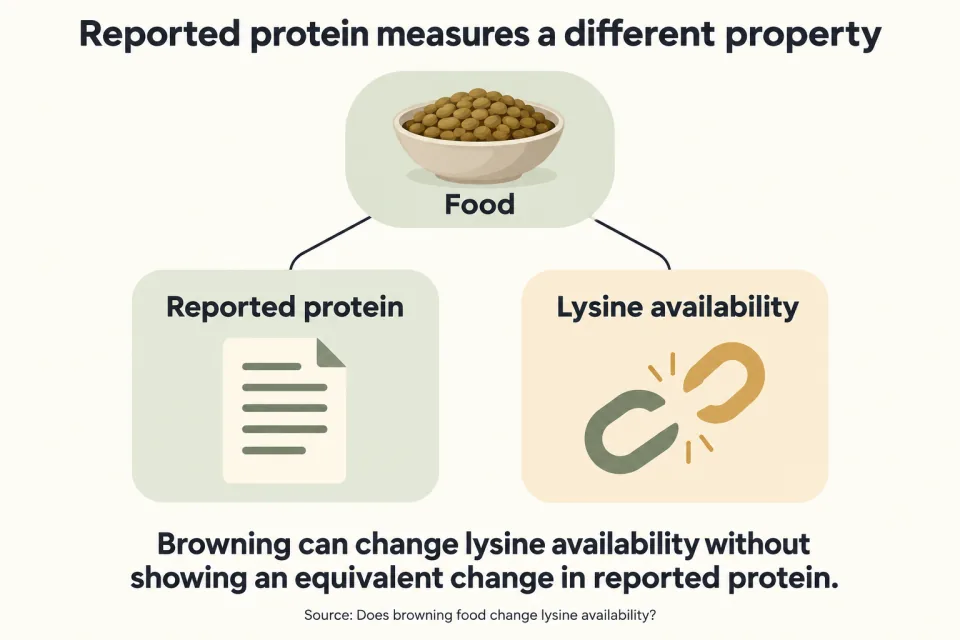
Browning can change lysine availability without showing an equivalent change in reported protein. Learn how sugar reactions, laboratory methods and recipe differences affect the comparison, and why color cannot measure the loss.
The journal's automated checks of this essay's content and sources passed on , and this version appeared after they did. Read the health disclaimer.
In this essay
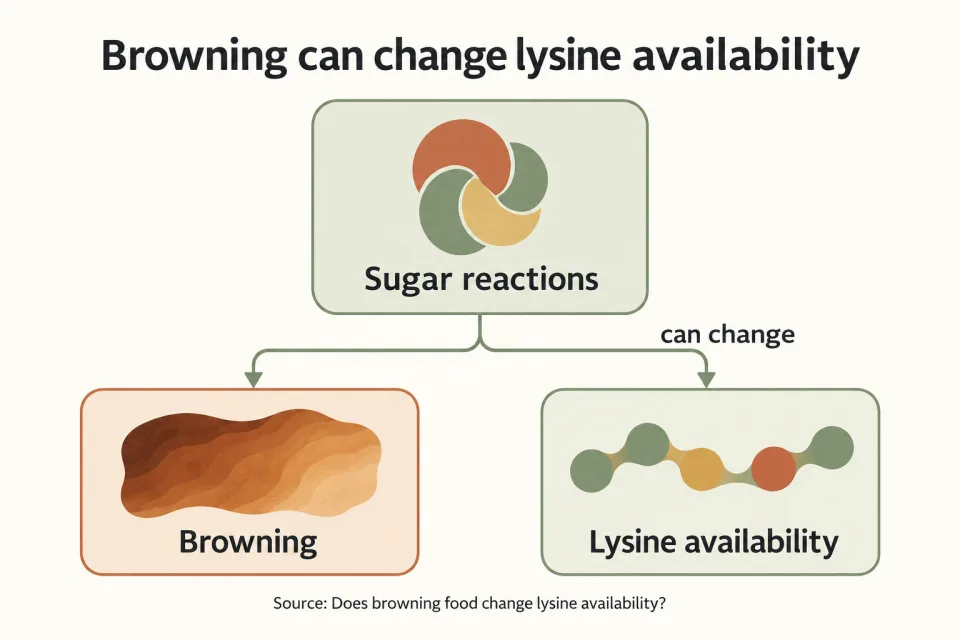
Browning can change lysine availability
Browning reactions involving sugars and protein can reduce the availability of lysine, but the color of a food cannot tell us how much has changed. The answer depends on the chemistry involved and on what the measurement called “protein” represents.
Lysine is an amino acid, a building unit in protein. Proteins contain chains of amino acids connected by links called peptide bonds. A measurement of the whole protein and a measurement of available lysine therefore describe different aspects of the same food: the amount of protein and the status of a particular amino acid within it.
The Maillard reaction is a network of reactions between certain sugars and amino groups supplied by amino acids, short amino-acid chains called peptides, or proteins. An amino group is the part of the molecule involved in this reaction. The American Society of Baking identifies glucose, fructose, lactose and maltose as sugars that can participate. These are called reducing sugars, a chemical category relevant to their ability to react.
Lysine has an amino group on its side chain, a branch of its molecular structure. The Food and Agriculture Organization of the United Nations, or FAO, explains that reaction between carbohydrate and this group can make lysine nutritionally unavailable. The important change is to the chemical form of lysine. Describing that change requires more information than the total protein figure provides.
This chemistry develops through stages. Later Maillard reactions form flavor compounds and brown pigments called melanoidins, according to the American Society of Baking. The familiar visible browning belongs to this broader sequence; it is not a direct reading of how much lysine remains available.
Ingredients and heating conditions help determine how the sequence proceeds. Temperature and exposure time affect Maillard browning, and the reactions can proceed more slowly at lower temperatures. A useful explanation of a browned food therefore needs the recipe and its processing conditions. “Browned” alone leaves out much of the information needed to understand the reaction.
Reported protein measures a different property
A change in available lysine does not establish an equivalent change in reported protein grams. Common protein measurements estimate the overall amount of protein without separately determining the availability of each amino acid. FAO describes protein, amino-acid and available-lysine analysis as distinct analytical tasks.
In the conventional approach, a laboratory measures nitrogen and multiplies the result by a conversion factor to estimate protein. The factor translates the nitrogen measurement into a protein value. This explains why a reported protein figure does not, by itself, answer a question about a particular chemical group on lysine: that group is not what the nitrogen measurement separately examines.
The conversion also involves assumptions about the food. FAO explains that nitrogen in food does not come exclusively from protein; compounds including nucleotides, creatine and choline contain nitrogen too. These are examples of other nitrogen-containing compounds, not additional forms of protein. Their presence helps explain why measuring nitrogen and directly measuring protein's amino-acid components are different analytical approaches.
Proteins also differ in their proportions of nitrogen because they contain different combinations of amino acids. Food-specific conversion factors accommodate differences between protein sources. A protein result should therefore be understood in relation to the method used to obtain it, rather than as a complete description of everything about that protein.
An alternative is to determine protein from measured amino acids. This approach avoids assumptions about non-protein nitrogen, although FAO notes that it requires more complex equipment than the conventional Kjeldahl nitrogen method. It answers the quantity question through the protein's components. Availability still requires attention to the chemical form being measured.
When comparing food before and after browning, keep the reported outcomes separate. A finding about available lysine describes available lysine; it does not supply a matching loss in total protein. Equally, a protein figure alone does not establish that lysine availability stayed the same. The distinction does not mean cooking always leaves protein content unchanged. It means that a result for either property cannot simply stand in for a measurement of the other.
Different lysine tests answer different questions
Measured lysine, reactive lysine and digestible reactive lysine describe different analytical questions. The names can sound interchangeable, but each identifies a different stage in assessing the food. Reading the method alongside the result helps establish what was measured.
For routine amino-acid analysis, laboratories normally release amino acids from protein through hydrolysis, a chemical process that breaks the links holding the chain together. They then separate the released amino acids by chromatography, a laboratory separation method. FAO notes that hydrolysis can itself degrade some amino acids, so the analysis needs to account for losses introduced by the method.
This preparation step matters when interpreting a result. An amino-acid analysis describes what a particular procedure recovered and measured. Before calling its lysine result “available lysine,” the method needs to establish that it measures availability. FAO's separate discussion of amino-acid analysis and available-lysine methods reflects that distinction.
Reactive lysine means lysine that remains chemically unmodified, as the research abstract hosted by the US Environmental Protection Agency explains. The term focuses on chemical status. Digestible reactive lysine adds the question of digestibility, meaning the extent to which that unmodified lysine is digested. The abstract identifies true ileal digestible reactive lysine as a measure of bioavailable lysine, distinguishing the digestible fraction from the chemically unmodified amount alone.
Specialized chemical methods examine lysine's reactive group. FAO describes the Carpenter method, which measures available lysine through reaction with fluorodinitrobenzene, a laboratory reagent. Another approach, guanidination, uses the reagent O-methylisourea to convert lysine into homoarginine through its side-chain amino group. These names describe analytical procedures, not ingredients or kitchen techniques.
The guanidination abstract explains that complete conversion is necessary for reliable measurement and that the required conditions can differ between foods, even between samples of the same food type. A named test therefore needs suitable conditions as well as a suitable purpose. For a reader comparing results, the practical distinction is straightforward: reported protein describes overall quantity, amino-acid analysis describes measured components, reactive lysine describes chemical status, and digestible reactive lysine includes digestibility. A paper's wording should identify which of those questions its result answers.
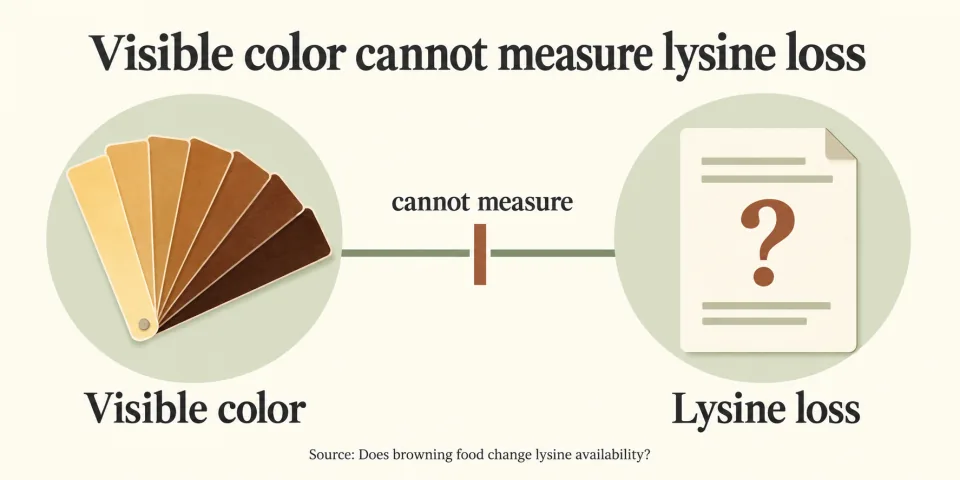
Visible color cannot measure lysine loss
The darkness of food cannot be translated directly into a loss of available lysine. Color is an outcome of several kinds of chemistry, and visible Maillard color appears after earlier stages of the reaction. Appearance provides context, but it does not replace a lysine measurement.
The textbook Food, Fermentation, and Micro-organisms explains that early Maillard compounds can be colorless before later reactions form colored compounds. Visible browning therefore does not mark the beginning of all Maillard chemistry. A comparison based only on a pale surface and a dark surface misses reactions that have not yet produced visible color.
Brown color can also arise without the sugar–amino-group reaction discussed here. The Exploratorium describes caramelization as heat-driven changes in pure sugar that form new compounds and color. Its example of cream-containing caramel candies involves different chemistry: sugar reacts with milk protein through the Maillard reaction. Similar-looking colors can thus have different chemical origins.
That distinction is especially useful when reading cooking descriptions that use “caramelized” broadly. A description of color or flavor does not establish which reaction was measured. The presence of protein in the cream-containing example is part of the explanation, whereas pure-sugar caramelization does not require the same sugar–protein interaction.
The textbook also distinguishes the browning of sliced apple from Maillard browning. In that example, enzymes drive oxidation of compounds called polyphenols. An apple surface, heated sugar and a browned baked crust should therefore not be grouped together as though their color necessarily records the same reaction. The word “browning” covers more than the lysine chemistry at issue.
Even within Maillard reactions, the route depends on the starting ingredients and their proportions, as well as the food's pH. The textbook describes different flavor profiles from brief heating at high temperature and longer heating at lower temperature. A temperature description alone is incomplete without exposure time and recipe context. These distinctions explain why a photograph or a color description cannot supply a numerical estimate of lysine availability.
A cookie experiment shows the importance of the recipe
A cookie experiment found that recipe changes affected color and available-lysine loss differently. The study, available through CONICET Digital, measured these outcomes separately while changing ingredients. It provides a concrete example of why browning cannot be used as a universal measure of lysine loss.
In that experiment, adding whey protein concentrate increased available-lysine loss and changed the instrument-measured color. The researchers considered its lactose content a probable explanation for the stronger color development. That explanation retains its uncertainty: the reported relationship does not establish that every use of whey protein concentrate produces the same result.
Soy flour behaved differently in the experimental cookies. It had no significant effect on available-lysine loss and affected color less strongly than whey protein concentrate. The contrast concerns these recipe changes under the study's conditions. It does not rank soy and whey as general food sources or establish a rule for other baked foods.
Water changed the reaction timing too. Increasing water in the experimental cookie recipe delayed Maillard reactions and caramelization. This result connects with the American Society of Baking's account of water availability: water affects how molecules move, while very high water activity slows Maillard reactions. Water activity describes water availability in the food, an aspect of the reaction environment rather than a reading of protein quantity.
Other baking ingredients can change that environment before color is measured. The American Society of Baking explains that milk solids can darken crusts by adding lactose and amino acids. It also notes that fermentation can reduce the sugars available for later browning because yeast and bacteria consume them. A finished crust reflects those ingredient and preparation differences as well as heating.
For interpreting the cookie findings, the useful comparison is between the outcomes actually recorded: color, available lysine and the recipe change. Color may track available-lysine loss within a particular experiment, but a different ingredient change can produce a different relationship. The study's separate measurements preserve that distinction. Collapsing them into a claim that darker cookies always have less available lysine would discard the recipe-dependent result.
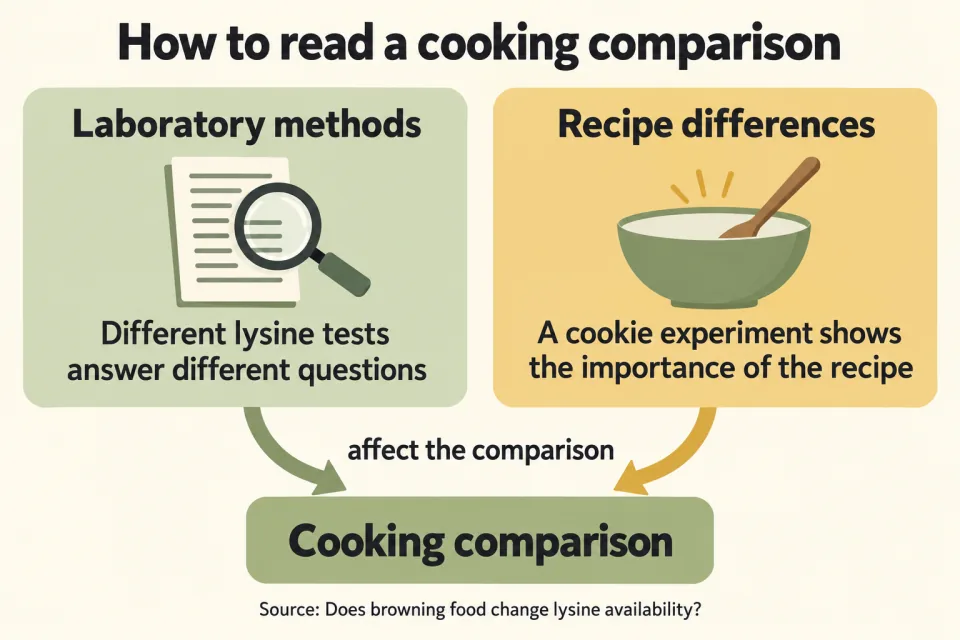
How to read a cooking comparison
A useful cooking comparison identifies the food, its preparation and the property being measured. The analysis in Frontiers in Nutrition argues that protein digestibility studies should examine foods in the form people consume. Raw-food measurements should not simply be assumed to describe the cooked version.
Begin with the question the comparison asks. If it concerns protein quantity, look for the method used to determine protein. If it concerns lysine availability, look for an available-lysine or reactive-lysine measurement and whether digestibility was assessed. This reading sequence prevents a broad phrase such as “protein loss” from hiding a more specific finding about an amino acid.
Next, keep the tested recipe attached to the result. In the cookie study, changing the protein ingredient and changing water did not describe the same experimental change. A comparison that omits those details loses information needed to understand its outcome. Likewise, a statement about Maillard chemistry during heating should retain the exposure time, temperature and ingredient context supplied by its source.
Processing also needs to be considered through more than lysine modification alone. The Frontiers in Nutrition analysis discusses changes in food structure and in compounds that affect protein digestibility alongside changes in amino-acid availability. These are distinct aspects of processing, so an available-lysine result does not by itself describe the full protein assessment of a cooked food.
The same analysis identifies digestible reactive lysine as the appropriate measure for accounting for lysine availability in protein-quality assessment of processed foods susceptible to Maillard changes. It also explains that Maillard-related changes in amino-acid availability can develop during storage as well as processing. The history of the food can therefore extend beyond the final heating step described in a recipe.
For an everyday explanation, keep the wording as specific as the evidence. “Available lysine changed” reports a different finding from “protein content changed,” and “the crust became darker” reports a different observation again. A useful account can connect those findings when an experiment measures them together. It should preserve the distinction when explaining what browning tells us about protein.
Notes
Works consulted
- Food Composition Data: Chapter 7: Review of methods of analysis
- Food energy: methods of analysis and conversion factors: Chapter 2
- Maillard Reaction
- Science of Candy: Caramelization & Caramels
- Use of the guanidination reaction for determining reactive lysine, bioavailable lysine and gut endogenous lysine
- Digestible indispensable amino acid score (DIAAS): 10 years on
- Effect of soy flour and whey protein concentrate on cookie color
- Food, Fermentation, and Micro-organisms, Second Edition: Chapter 1 excerpt
From the journal's records
No writer is named: the essay is credited to the journal, Protein Networks.
It cites 8 sources.