 Protein Networks
- Protein Networks
- Do dietary protein guidelines require protein powders?
An essay
Do dietary protein guidelines require protein powders?
Learn what population protein guidance describes, how ordinary foods fit within it, and why protein powders remain optional. The distinction between protein amount, amino acids and supplement labels helps explain the answer.
The journal's automated checks of this essay's content and sources passed on , and this version appeared after they did. Read the health disclaimer.
In this essay
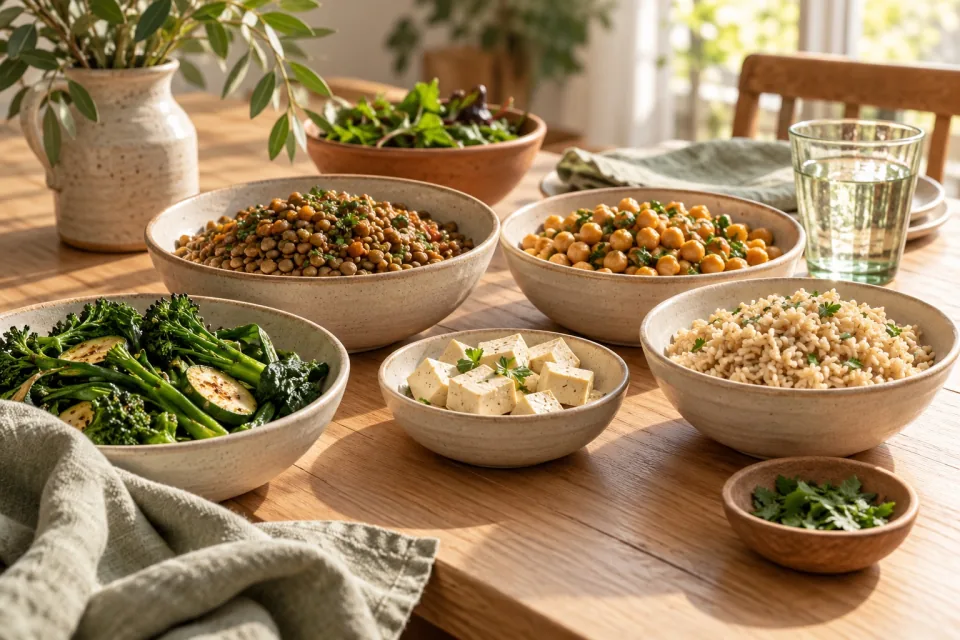
Protein guidance does not require a powder
Taken together, the sources discussed here support the conclusion that dietary protein guidance does not require everyone to use protein powder. This is a synthesis of guidance about dietary patterns, population reference values and the place of supplements. The distinction is between describing protein in a diet and specifying the form in which it must be eaten.
The clearest statement about food and supplements comes from NIH ODS, the US NIH Office of Dietary Supplements, which says athletes can probably meet their protein needs through food, with supplements or fortified foods available if needed. That statement concerns athletes, so its scope should remain attached to it. Even in that context, however, food is an ordinary route to protein and a supplement is an option. Reading it as a requirement to use powder would change the advice.
The World Health Organization says dietary protein can come from a mixture of animal and plant sources. Its discussion places protein within an overall eating pattern. EFSA, the European Food Safety Authority, provides the protein reference framework used in the Dutch evaluation. These approaches allow protein to be understood across the foods eaten, without assigning the whole role to a separate powder.
A reference value and a description of a supplement therefore answer different questions. The reference value concerns a nutrient intake for a defined group. A description of whey or another powdered protein explains a possible source of that nutrient. Putting these statements beside each other does not turn the source into a compulsory way of meeting the reference.
This distinction gives the discussion a useful starting point. Ask what the guidance describes before asking which powder might fit it. A statement about dietary protein can be relevant to meals containing beans, eggs, fish or dairy foods, as well as to a diet that includes a protein supplement. The presence of a supplement in the discussion does not change the meaning of the guidance.
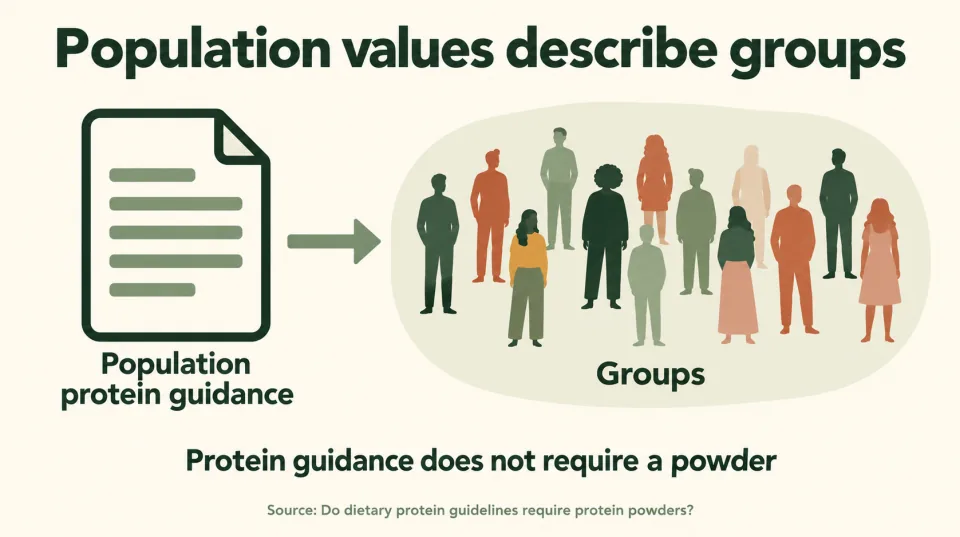
Population values describe groups
A population reference intake describes an amount considered adequate for virtually everyone in a defined population group. The European Commission's Joint Research Centre uses this meaning in its glossary. The word population is part of the definition: the reference concerns a group, rather than a calculation made for a particular reader.
Understanding the group is therefore part of understanding the value. A reference cannot be interpreted fully by lifting its amount out of the surrounding explanation. The population, the way the amount is expressed and the criteria behind it belong together. Treating the figure alone as a personal instruction removes the context that gives it meaning.
The Joint Research Centre explains that organisations use different terms for recommended protein intakes because their underlying criteria differ. Similar-looking labels are not necessarily interchangeable. Before comparing recommendations, it helps to establish whether the organisations are describing the same kind of reference. A difference in terminology can reflect a difference in the question being answered, rather than a disagreement about foods.
The Health Council of the Netherlands based its evaluation of protein reference values on EFSA's dietary reference values. The Dutch Council attributes its somewhat higher values expressed in grams per day to its population being taller and heavier than the European average. This is a concrete example of population assumptions affecting how a reference is expressed. The difference can be explained without introducing any requirement for a particular protein source.
The Dutch example also shows why comparing isolated daily amounts can be misleading. If population body size affects the translation into a daily amount, a comparison needs to retain that explanation. Otherwise, the reader may mistake a difference in assumptions for a change in the basic framework. Neither the daily unit nor the population adjustment identifies a food or powder that must supply the protein.
For an article explaining guidance, the useful comparison is therefore between definitions and scope before it is between amounts. Which group does the reference describe? What assumptions accompany it? Those questions help keep population guidance in its proper role, without turning an explanatory article into an individual target or a powder schedule.
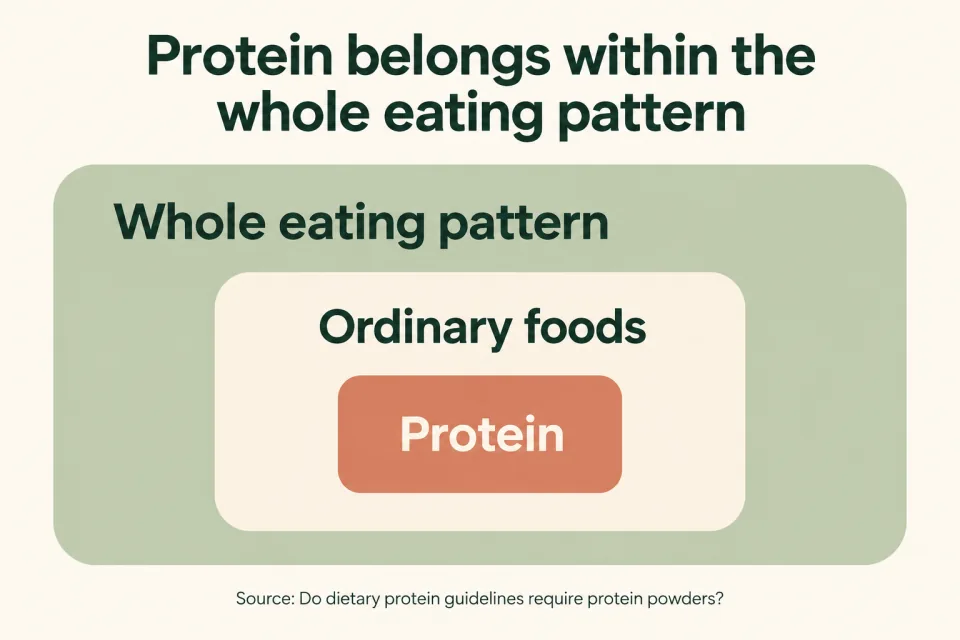
Protein belongs within the whole eating pattern
The World Health Organization places protein within a dietary framework built around adequacy, balance, moderation and diversity. Protein is part of that framework, rather than a separate subject that can be understood solely through a supplement label. Reading the protein statement alongside the dietary framework preserves the context of the guidance.
For adults, the World Health Organization expresses general protein guidance as a share of total dietary energy. That form describes protein in relation to the whole diet. A percentage of dietary energy and a description of a protein powder are different kinds of information: the former concerns the composition of an eating pattern, while the latter concerns a particular source. Neither should silently be substituted for the other.
The World Health Organization's account of balance includes protein, fats and carbohydrates, alongside the relationship between energy intake and expenditure. This makes a protein-only reading incomplete as an explanation of the guidance. A food comparison can focus on protein for a specific purpose, but that narrow comparison does not reproduce the whole dietary framework. The scope of the comparison needs to remain clear.
Dietary diversity, in the World Health Organization's account, means including varied nutritious foods within food groups and across them. Those are related but distinct forms of variety. Changing foods within a group addresses a different part of the description from including foods across groups. Reducing diversity to a choice between powder flavours would miss what the guidance is describing.
The World Health Organization also says the composition of a balanced diet varies with cultural context, locally available foods, dietary customs and individual characteristics. This leaves room for different food traditions within the same broad framework. An explanation for an international audience therefore need not make a particular country's familiar meals the default for everyone.
The practical reading is to keep the whole eating pattern visible when discussing protein. A passage about protein sources belongs beside the guidance on variety and balance, rather than replacing it. This also makes the role of a powder easier to describe: it can be discussed as a source of protein without being presented as the definition of an adequate or varied diet.
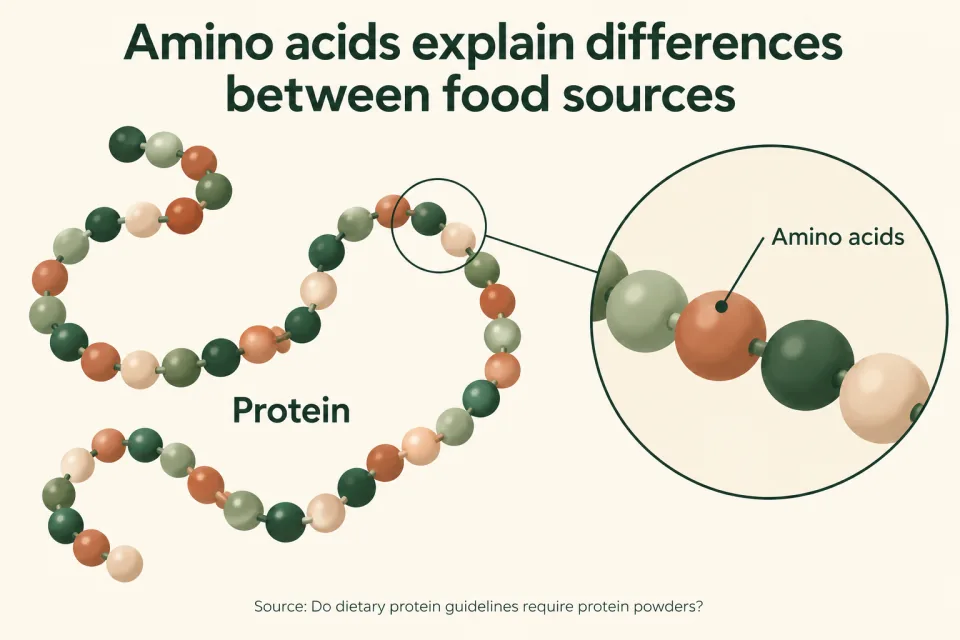
Amino acids explain differences between food sources
Protein sources differ in their amino acids as well as in their protein content. Amino acids are the components from which proteins are made. Essential amino acids must come from the diet because the body cannot make them. These terms explain why a discussion of protein can involve more than its total amount.
NIH ODS distinguishes protein quantity from protein quality in its guidance for athletes. Quantity concerns how much protein a food or diet supplies. The amino acid composition adds another part of the description. Keeping these questions separate avoids using a statement about total protein as though it also explained every difference between protein sources.
NIH ODS lists meat, poultry, fish, eggs and dairy foods as sources containing all the essential amino acids. It also explains that eating different kinds of plant foods, including grains and legumes, is a way to obtain all the essential amino acids. These statements describe routes through food. The distinction between animal and plant sources does not create a separate requirement for powder.
The Joint Research Centre explains complementary plant proteins through differences in their amino acid composition. Cereal proteins are relatively low in certain essential amino acids, including lysine. Legume proteins tend to be limited in sulphur-containing amino acids. Complementary proteins are sources whose differing amino acid patterns can be considered together within a varied diet.
For a food example, consider a grain dish alongside beans. The useful question is how the different protein sources contribute to the eating pattern. This example illustrates the relationship between food groups; it does not assign a nutrient total to the meal. Likewise, a meal containing eggs or fish illustrates the animal-food sources described by NIH ODS without establishing a serving comparison.
The European intake discussion on the Joint Research Centre's protein page identifies meat, grain-based foods and dairy foods as major contributors to adult protein intake in most European countries. Grain-based foods therefore belong in the discussion of where dietary protein comes from, even when attention is focused on more obvious protein foods. Describing the whole diet means recognising its different contributors.
These distinctions make food comparisons more precise. A statement about amino acids should be read as a statement about amino acids, and a measured protein amount should be read as an amount. Powder format alone does not answer either question. The source of the protein and the information being compared need to stay visible.
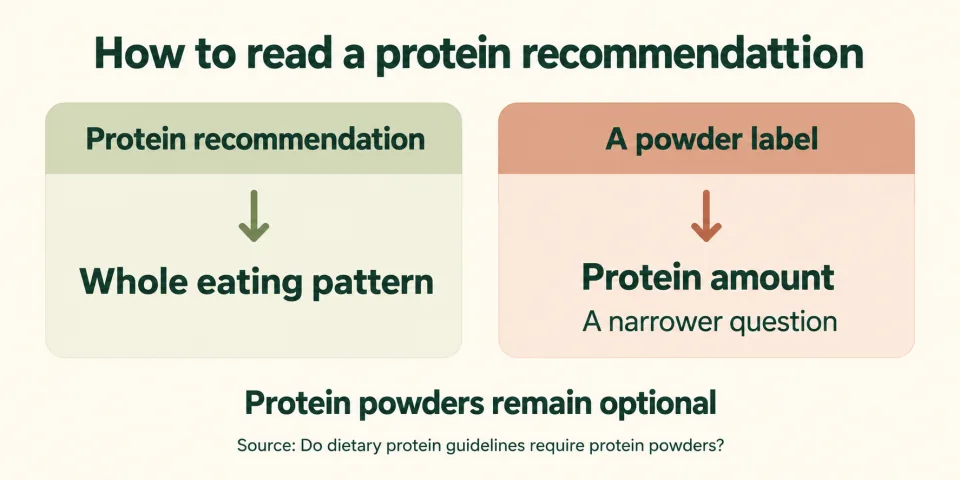
A powder label answers a narrower question
A supplement label describes the contents of a stated serving, while dietary guidance describes a broader nutritional context. NIH ODS explains that a Supplement Facts label identifies active ingredients and their amounts per serving. That information can describe what is present in the supplement. It is not, by itself, a population recommendation.
The serving basis matters when interpreting the label. An ingredient amount is attached to the serving described there, rather than floating independently of it. Reading the ingredient and the serving together preserves the meaning of the label. It also keeps a description of contents separate from an instruction about how much a person should use.
The protein source is another part of the description. NIH ODS identifies whey as a complete protein isolated from milk and commonly used in protein powders and drinks. Here, complete means that the protein contains all the essential amino acids. The term describes its amino acid composition; it does not turn the powder into a complete description of a diet.
NIH ODS also discusses casein, the main complete protein in milk, and supplements that combine different protein sources. A powder category can therefore contain different protein ingredients. The words protein powder alone do not specify which source is present. Looking at the named ingredients answers that narrower question without ranking formats or assigning a supplement routine.
Supplement labels also identify other ingredients, such as fillers, binders and flavourings, according to NIH ODS. The protein ingredient and the other ingredients are separate parts of the label's description. Reading both avoids treating the name on the front as the full account of what the serving contains. None of these label details changes the population or scope of an external dietary recommendation.
NIH ODS says supplements cannot replace the variety of foods in an eating routine. This fits the distinction between a label and an eating pattern: a label provides information about a serving, whereas variety concerns the foods included across the diet. A powder can be discussed accurately without asking it to stand in for that wider description.
For a comparison with food, the same separation is useful. Compare the protein source when the question is about amino acids, and compare stated serving contents when the question is about amounts. Keep both distinct from the question of whether guidance requires a supplement. More detail on a label does not broaden what a guideline says.
How to read a protein recommendation
A useful way to read protein guidance is to separate its population, its nutrient statement and its discussion of food sources. These parts can appear close together, but each has a different role. Working through them in sequence makes it easier to see where the guidance ends and an interpretation begins.
Start with the population named in the passage. In this set of sources, the World Health Organization gives general adult guidance, while the NIH ODS exercise fact sheets discuss athletes. Retain that distinction when explaining either source. Moving a statement from its named group to everyone would broaden the claim beyond the wording being explained.
Next, identify what kind of statement the passage makes. A population reference intake describes adequacy for a group. Guidance expressed as a share of dietary energy describes protein in relation to the diet's energy. A supplement label describes ingredients and quantities in a serving. These descriptions should not be joined as though they were successive instructions leading to a scoop of powder.
Then read the food-source statement on its own terms. The World Health Organization allows a mixture of animal and plant protein sources, and NIH ODS describes food as a probable way for athletes to meet their protein needs. Those statements give food a direct place in the explanation. Adding a paragraph about whey does not cancel that place or establish that whey is required.
Consider how this works in a comparison of a mixed-food eating pattern with an eating pattern that also includes powder. The population reference keeps the same meaning in both descriptions. The source discussion changes because the latter includes another protein source. The presence of powder tells the reader something about the diet's contents, but does not by itself establish that the diet follows the guidance more closely.
A similar distinction applies when comparing national reference values. The Dutch explanation concerns population body size and the expression of a daily amount. It should be assessed as an explanation of those reference values. Moving from that explanation to a claim about needing powder would introduce a different question that the population comparison has not answered.
The resulting interpretation is straightforward: describe the group, preserve the meaning of the reference, and account for protein from the foods included. If a powder is part of the discussion, describe its protein source and stated serving contents separately. This keeps dietary guidance readable without turning it into a supplement instruction.
Notes
Works consulted
From the journal's records
No writer is named: the essay is credited to the journal, Protein Networks.
It cites 7 sources.